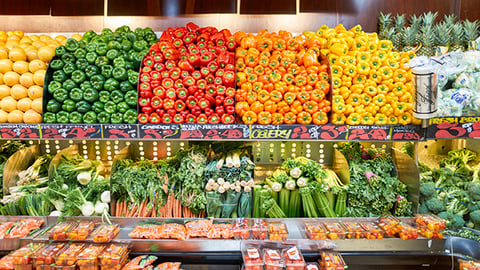
Food-safety tips fresh from the produce department

Everyone knows they need to eat fruits and vegetables to reap their many health benefits. Yet, as shoppers sniff melons, inspect berries and discern the best-looking lettuce, an unseen risk may be lurking—one that could make them seriously ill.
While Canada’s food supply is among the safest in the world, the Canadian Food Inspection Agency notes that fresh produce can still become contaminated by harmful bacteria, viruses or parasites if not properly handled, stored or transported. In recent years, food-borne illness outbreaks have been linked to items such as cantaloupes, tomatoes, leafy greensand herbs.
As the last stop before fresh produce reaches consumers’ fridges, grocers play a critical role in ensuring a safe supply. Here’s a look at best practices to bolster fresh produce safety.
Staff training keeps knowledge fresh
Food-safety training—covering essentials from handwashing to cleaning—is legally required in many parts of Canada for those handling food. Retraining and refreshing also keeps food safety top of mind.
“At Summerhill Market, we train our produce team on key areas, including proper handling, temperature control, first-in-first-out rotation, cleanliness and identifying spoilage. We also emphasize the importance of regular visual inspections,” says Bart Desiron, director of prepared foods, who also manages the retailer’s food-safety program.
Training doesn’t have to be boring, either. “There is a lot of innovation and training to meet employees where they are—long gone are the days where employees sit in a classroom-type setting for hours and hours,” says Hilary Thesmar, chief science officer and senior vice-president, food at FMI - The Food Industry Association. “It’s become more interactive and digital—there are programs that even use gamification. It’s a fun thing to keep employees engaged.”
On the receiving end, Desiron says when produce arrives, the team checks temperatures, inspects packaging and looks for any signs of spoilage or damage. “Anything that doesn’t meet our standards is documented and flagged immediately to our produce buyer,” he says. “Product is moved into cold storage without delay to maintain the cold chain.”
Stay close to suppliers
Even the best in-store food-safety practices can be undermined if suppliers aren’t meeting
proper standards. “We want to make sure the incoming product is not contaminated. And so, knowing the supplier is important—knowing what their food-safety practices are and making sure they’re compliant with government regulations,” says Thesmar.
In Canada, supplier certification programs such as CanadaGAP and Primus-GFS—two Global Food Safety Initiative (GFSI) programs—are well entrenched, notes Jeff Hall, senior director of food safety and innovation at the Canadian Produce Marketing Association. “All of the retailers I’m aware of have systems in place where they require their supply chains to follow a GFSI program,” he says.
Hall stresses the importance of grocers staying close to the source. Because fresh produce items are often not branded, “customers think of it as being the grocer’s product—almost like private label,” he says. “So, retailers have a lot to protect when it comes to their reputation and their supply chains. It’s important that retailers have a view on where those products are coming from and how they’re getting to the stores.”
Summerhill Market takes a hands-on approach. “Our in-house produce buyer works directly with reputable suppliers who are either certified by third-party food safety programs or have long-standing, trusted relationships with us,” says Desiron. “When possible, we also visit supplier facilities to observe their processes first-hand.”
Responding more quickly—and digitally—to recalls
Even with strict food-safety practices in place, incidents can still happen. That’s why strong traceability is critical. While there are a variety of effective traceability methods in place, “the focus today is, how do you leverage technology and global standards to digitize that same supply chain?” says Pam Horvatis, senior vice-president, industry relations at GS1 Canada, which develops and maintains global standards and barcodes.
READ: Recalls will happen, but how they’re handled can make all the difference
With traceability standards such as the Global Trade Identification Number, Horvatis says grocers can identify affected products more precisely and act faster to a safety issue. “Rather than having to wipe out all your stock ... you can now identify the specific locations this product came from,” she says. “And the quicker we can identify where the product came from, the quicker we can react.”
This article was first published in Canadian Grocer’s September/ October 2025 issue.