
Trade uncertainties continue to affect Canadian economic growth

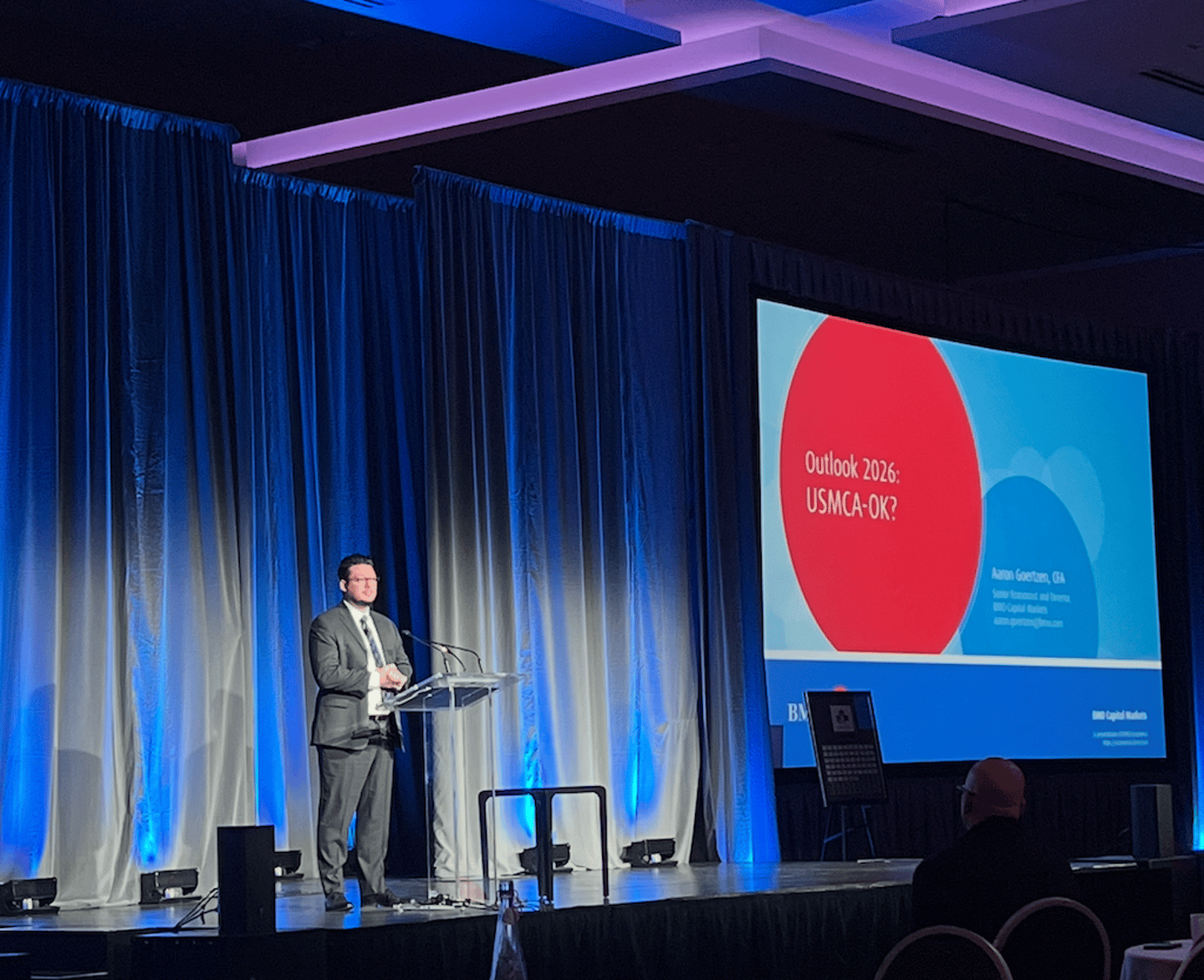
Aaron Goertzen, senior economist and director, BMO Capital Markets, took the stage on day one of Grocery Innovations Canada in Toronto this week to provide insights on the state of Canada’s economy.
“Canada's economy has been staggering from the last couple of years, seeing 1.6% growth in 2024 with more than 3% in population growth,” says Goertzen.
There is a much greater rate sensitivity in Canada, with much higher household debt levels.
Trade uncertainties continue to affect Canadian economic growth, projected at 1.2% for 2025. Commodity prices, especially metals and energy, showed mixed trends, impacting regional growth.
Canada's core inflation rate is sitting above 3%, with all-in inflation at 8.9% year-over-year. The Bank of Canada is expected to cut rates further to mitigate economic risks.
Trade policies and tariffs
Canada has seen the damage from uncertainties around the tariffs and trade beginning to mount. However, Goertzen notes that things are better than feared for Canada.
“Overall, Canada's facing an average tariff rate of more like 7% on our exports into the U.S., and so if we want to find silver linings, we're doing a little bit better than other U.S. trading partners, on average.”
Goertzen also says there is some volatility to Canada with the upcoming review of the United States–Mexico–Canada Agreement (USMCA).
Looking back to earlier this year, Canada saw tariff developments that were all occurring around the same time across various sectors of trade.
“From the Canadian perspective, it's worth saying that we're not facing average tariffs. There's no blanket tariff in place on U.S. imports from Canada. At present, there are sectoral tariffs that affect some of our very important industries like steel, living, autos, goods not covered by a trade deal in the US are subject to actually pretty high tariffs at this point. “
Agriculture prices have trended steadily lower over the past years, very heavily skewed to crops.
“We are coming off of a couple very strong global harvests, and crops were exposed to trade frictions,” says Goertzen. “It’s been a very different story for livestock, particularly cattle. Beef prices have experienced successive record highs, while hog has fallen for the seventh consecutive year. There’s not much indication that supply is going to be improving.”
Consumer confidence
In March 2025, when across-the-board tariffs came into play between Canada and the U.S., business and consumer confidence fell to the lowest level, not just since the pandemic or the global financial crisis, but ever.
Despite low confidence, consumer spending has remained strong, despite less demographic support, slower population growth and lower levels of immigration.
“One thing that's been very interesting to me over the course of the year is how consumers and businesses are reacting to all this uncertainty in very different ways,” says Goertzen.
Canada’s business investments are “on track to decline,” mainly attributed to uncertainty.
“There will be a continued and sustained pressure on business investments in Canada going into 2026.”
Unemployment is up to about 7% in Canada, however there are few employment opportunities compared to the number of Canadians entering the labour force.
Regional economic outlook
“Obviously, our entire country is on the trade defensive with the U.S., vulnerable to cross border tariffs, but there are pretty big differences when you look across the landscape,” says Goertzen.
Canada is coming out of a period where regional growth disparities were focused on rates and has now shifted to trade exposure.
B.C. has seen a relief in pressure due to low U.S. trade exposure, while Ontario is still at the centre of economic risk given its high exposure.
Alberta is also much less exposed. Commodity prices are in respectable shape for the energy sector, driving stronger outcomes.
Typically, commodity prices have a larger impact on relative growth rates regionally across Canada than they do right now.