
Leaders say grocery code needs ‘broader participation from independents’ to be successful

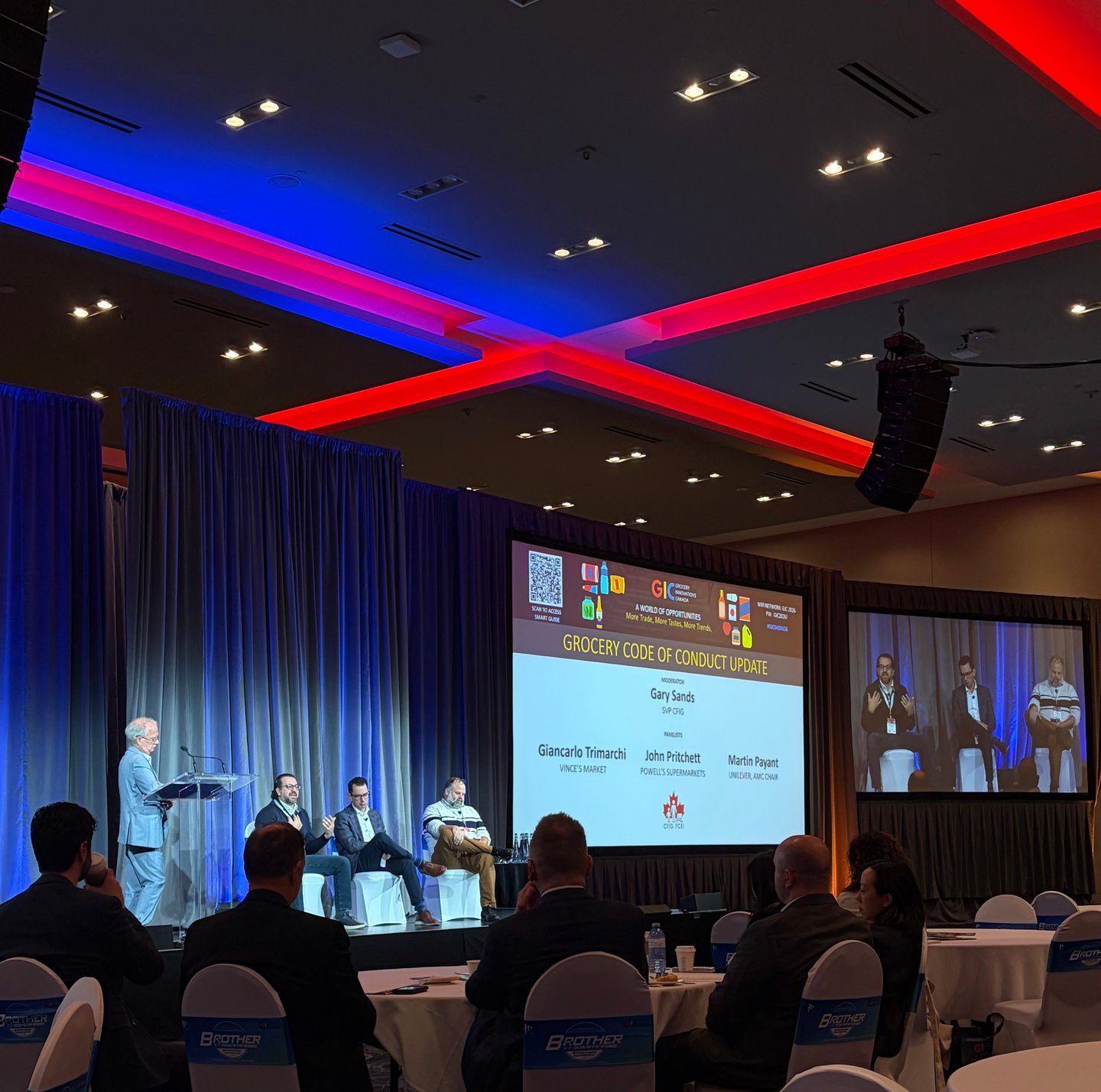
Canada’s Grocery Code of Conduct needs more participation from independent grocers if the framework is going to be successful, leaders say.
“We haven’t had the uptake on membership from independents that we thought we’d have, and that I think we’re going to need to have as we move forward,” John Pritchett, general manager of N.L.-based Powell’s Supermarkets, said in a panel discussion at the Canadian Federation of Independent Grocers’ (CFIG) Grocery Innovations Canada event in Toronto last week.
The panel also included Giancarlo Trimarchi, president of Ontario-based Vince’s Market and Martin Payant, vice-president and chief customer officer of Unilever Canada, with Gary Sands, senior vice-president of policy at advocacy at CFIG, serving as moderator.
“Not signing up is actually a decision and a statement,” Pritchett told attendees, warning that low participation could lead to government intervention.
“What we have is a generational opportunity to set up a framework that allows our industry to exist in its best form. We may lose that because of apathy.”
READ: Grocery code office president on how members can raise issues
Trimarchi agreed: “If this code office doesn't function on a voluntary basis, the writing's on the wall that the government will see that as an opportunity to regulate. And the fear there is… our food system and our businesses are regulated provincially, not federally. So unless there is an active agreement on everyone to get together, it would be so overly complicated.”
The voluntary, industry-led Grocery Code of Conduct came into force on Jan. 1. Signatories include Costco, Empire Co., Loblaw, Metro and Walmart, along with more than 150 small grocers. Members of the board of directors—including Pritchett, Trimarchi and Payant—were elected in April.
Sands reminded attendees that the code was a hard-won victory for the industry.
“We fought for this. This is not a retailer code of conduct, which exists in other countries. This is a grocery code of conduct,” Sands said. “The principles are built on the foundation of reciprocity. It applies to everyone… The code doesn't level the playing field in terms of, the industry is structured the way it's structured. But you're treated equally whether you're a small supplier or a large supplier; an independent retailer versus a large retailer.”
Code is "not a stick"
Payant said while small vendors may be reluctant to raise issues, particularly with large retailers, the code offers a shared vocabulary to facilitate conversations.
“Don't see the code as a stick. It's not a stick. It's a way to engage in a conversation,” Payant said. “You don't have to bring the issue straight to the retailer. You can bring it to the [Office of the Grocery Code of Conduct]... I see it as a bridge to help us move in the right direction.”
The code is anchored by a Dispute Resolution Management Process (DRMP) that serves as a formal backstop when informal discussions between retailers and suppliers fail.
Trimarchi said Vince’s Market has developed a retailer-led member agreement that sets out the rules of engagement between the grocer and its vendors using code language.
“There's an opportunity to go into the code and pick up the things in your business that you think you can benefit from,” he said.