Walmart posts 5.9% revenue growth in Q2
Walmart Inc. reported second quarter fiscal year 2027 revenue of $187.9 billion, up 5.9% (5.1% in constant currency), a boost the retail giant credited to digital sales channels and steady share gains. The Bentonville, Ark.-based company also raised its full-year outlook, citing continued strength in e-commerce, advertising and membership income.
Global e-commerce sales saw a 23% boost for the quarter, while Walmart’s advertising business grew 38% worldwide. Operating income reached $9.4 billion, a 28.8% jump that included a boost from tariff refunds; on an adjusted, constant-currency basis, operating income grew 17.4% to $9.2 billion. GAAP earnings per share came in at $0.80, down 9.1% from a year ago, while adjusted EPS rose 19.1% to $0.81, after stripping out a $0.12 net loss tied to equity investments and an $0.11 benefit from a tax matter.
Walmart International recorded net sales of $35.67 billion, up 7.9% year-over-year (constant currency). E-commerce sales rose 19.1%. The retailer said it saw double-digit sales increases across key merchandise categories in the quarter. Growth in operating income, which increased 5.7% to $1.3 billion, was driven by improvements in e-commerce economics led by China, India and Canada. Membership fee revenue grew with strength in key markets and Walmart's advertising business grew 20%, led by Flipkart Ads, the company said. Total revenues for Walmart International were $34.08 billion, up 7.9%.
“Our team delivered another good quarter, and we continue to make steady progress on the long-term value drivers of our business,” said John Furner, Walmart’s president and CEO. “Our multi-year growth in e-commerce is evidence that customers are choosing Walmart because we deliver price, speed and convenience across a broad assortment.”
Walmart U.S. comp sales slow amid pharmacy headwinds
Walmart’s U.S. segment posted net sales of $125.2 billion, up 3.5%, while comparable sales excluding fuel rose 2.6%, a marked deceleration from the 4.6% comp growth recorded in the same quarter last year. The company blamed roughly 125 basis points of that slowdown on pharmacy deflation tied to maximum fair price regulation that took effect Jan. 1, along with brand-to-generic drug transfers.
Transactions excluding fuel rose 1.5%, while average ticket ticked up 1.1%. Store-fulfilled delivery jumped 43% for the quarter, and marketplace sales climbed 52%. Walmart Connect, the retailer’s advertising arm, grew 43% excluding Vizio. According to Walmart, nearly 37% of store-fulfilled orders arrived in under three hours.
Gross profit for the U.S. segment reached $36.8 billion, up 9.4%, with the gross margin rate climbing 158 basis points to 29.4%. Walmart said this was due to tariff refund benefits and a stronger mix from digital advertising, though price investments and higher fuel-related distribution costs partially offset those gains. Operating income for Walmart U.S. rose 20.6% to $8.1 billion.
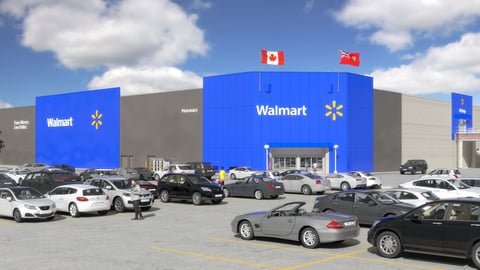
READ: Walmart Supercentre coming to Brampton, Ont. next year
By category, grocery comp sales grew in the mid-single digits, which got a jump from pantry and fresh food performance. Health and wellness comps fell in the low single digits, weighed down by a roughly 900 basis point hit from pharmacy deflation. General merchandise comps rose in the low single digits, with toys and fashion leading the way and private brand penetration up 130 basis points.
The chain opened one new Neighborhood Market during the quarter and completed about 220 store remodels; year to date, it has opened three Supercenters and one Neighborhood Market alongside roughly 280 remodels.
Sam’s Club posts strongest comp growth in 5 quarters
Sam’s Club U.S. delivered net sales of $25.7 billion, up 8.8%, with comparable sales including fuel jumping 8.5%, the segment’s strongest showing in the trailing five-quarter stretch. Excluding fuel, comps rose 4.4%. Transactions excluding fuel saw a 7% spike.
Operating income for the segment reached $678 million, up 44.3%, while adjusted operating income grew 23.3% after excluding the lapping of prior-year reorganization charges.
E-commerce sales at Sam’s Club grew 26%, now accounting for roughly 20% of net sales excluding fuel, an increase of about 350 basis points year over year. Club-fulfilled delivery posted triple-digit growth, and membership fee revenue rose 6%, driven largely by Gen Z and Millennial sign-ups, who made up more than half of new memberships with Plus tier penetration exceeding 50% in that cohort.
Company raises full-year guidance
Walmart lifted its fiscal 2027 guidance, now projecting net sales growth of 4% to 5% in constant currency, up from an earlier range of 3.5% to 4.5%. Adjusted operating income guidance rose to a range of 7.0% to 8.5%, compared with the prior 6% to 8% outlook, and adjusted EPS guidance moved to $2.80 to $2.87 from $2.75 to $2.85. Capital expenditures are now expected to run at approximately 4% of net sales, up from the earlier 3.5% estimate.
For the third quarter, Walmart guided to net sales growth of 3% to 3.75% in constant currency, operating income growth of 2% to 4%, and adjusted EPS of $0.62 to $0.64.
“Our business model is only getting stronger and more durable, and we're pleased to raise our guidance for the year,” said John David Rainey, Walmart’s EVP and CFO. “For Q3 sales guidance, we expect a headwind of over 100bps to growth related to a timing shift of Flipkart’s Big Billion Days between Q3 and Q4. Our operating income outlook reflects the continued prioritization of tariff refunds received in Q2 into customer experience and price investments in the second half. For this reason, I encourage you to consider Q2 and Q3 performance together to assess the underlying growth of the business.”
Walmart ended the quarter with $11.5 billion in cash and cash equivalents and total debt of $57.2 billion. Operating cash flow reached $19.7 billion year to date, up $1.4 billion from the prior year, while free cash flow fell to $5.5 billion, a $1.4 billion decline driven by a $2.8 billion increase in capital spending tied to the company’s omnichannel buildout.
This article was first published on Canadian Grocer's sister site, Progressive Grocer.
With files from Canadian Grocer