
Ways to revitalize the plant-based meat category
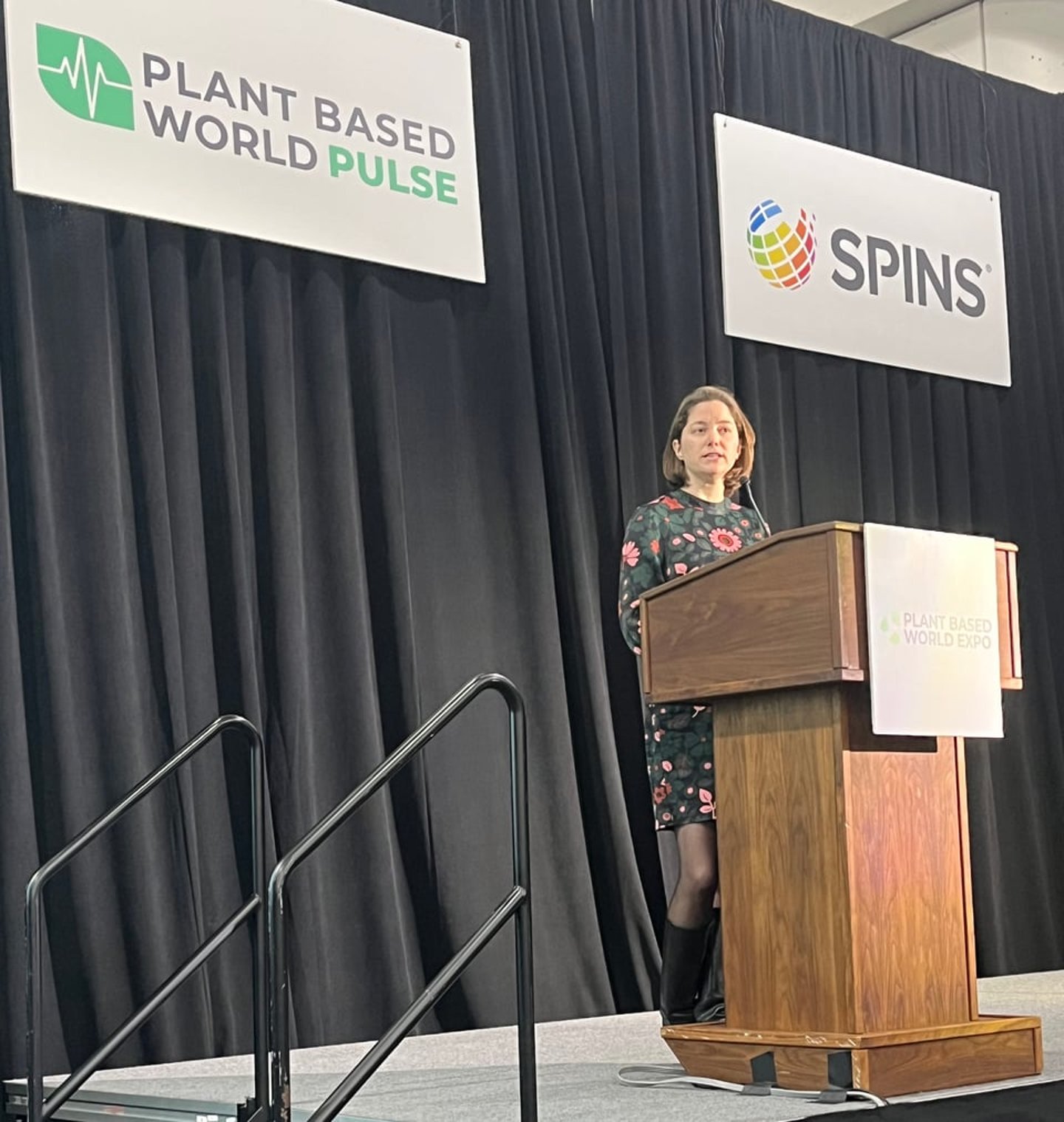
It hasn’t been the best of times recently for plant-based foods. Abby Sewell, corporate engagement manager of The Good Food Institute (GFI), admitted as much during her presentation, “Winning Back Consumers: How to Grow the Plant-Based Category in an Evolving Market,” on the second and final day of Plant Based World Expo North America, held Dec. 2-3 at New York City’s Javits Center. However, Sewell was then able to offer some constructive advice for brands and even retailers eager to succeed in that space.
“I don’t want to sugarcoat it: It’s a tough time for the plant-based category,” she asserted at the beginning of her presentation. “It’s reality, but then there are also some nuances to some of the negative headlines that we’ve been seeing.”
Some of those nuances: The sector saw approximately $8.4 billion in sales in 2024, with the biggest proportion attributable to plant-based milks, and although most subcategories were down from previous years, a few bright spots included plant-based protein liquids and powders, particularly in the natural channel; plant-based bars, which rose slightly; and tofu, tempeh and seitan.
Regarding plant-based meat, Sewell noted that “sales have been down year over year, but if you step back, you really see that there has been quite significant growth over about 14 years. … So, although it’s been hard in the last few years, we really see this as an opportunity. The market is mature, it’s evolving, it’s understanding what works, what doesn’t work.” She added that global plant-based meat sales were continuing to grow, especially in Europe.
READ: Researchers find benefits in using more of the plants we grow to produce food
One key opportunity is that “the plant-based meat shopper is more value built than the average shopper,” Sewell explained. “We find that in-store, the plant-based meat shopper goes in about 15 more times than the average shopper, and they also are spending $513 more over the course of a year. … [T]hey’re [also] buying more online than your average shopper.”
Beyond that, “the category has been defined by innovation, [since] it hasn’t been around for that long. These brands that are out there today, … they’re still innovating … [a]nd what we’re seeing in the last [couple of] years is that some of the newest products within plant-based meat and seafood are some of the most innovative and the most recently launched products. Those are things like filets, steaks and cutlets, shreds, chunks, and strips. And these are some of the brands that have seen an uplift over the last two years.”
Going back to 2018 and 2019, when the category was being built, Sewell reflected on what initially attracted consumers to plant-based items: “They wanted to understand these products, [and] they were interested in nutrition; they felt that [these offerings] were more nutritious than conventional meat [and] they thought that these products would taste really good.”
Taste and Price
As to what would bring consumers back to the category, it came down to two key attributes: taste and price. Sewell referred to these factors as “the top drivers of consumer food choice. You have to have these food items taste good for you to want to continue to buy them, and to drive that velocity and price.” She also pointed out that many of these products “have extremely high price premiums that are just not affordable for people in their weekly grocery shopping.”
Sewell went on to share data from fellow nonprofit Nectar showing the disparity many consumers found between animal-protein products and their plant-based counterparts when it came to taste, particularly for bacon.
Meanwhile, citing GFI’s annual analysis of price of plant-based products versus animal-based products, she noted that price premiums were “still very significant. It’s on average … about two times the price of conventional. … Beef is where we see the closest [price differences]. It’s really, really close. There’s still a price premium, but it’s pretty close. But we do notice that … the consumer feels that [price premium] and ultimately does change in terms of what they’re purchasing.”
Following a price promotion analysis with NielsenIQ, “one of the insights that we found was that it really depends on what’s going on in the collective market,” Sewell explained. “How much are the prices of your conventional meat when you’re pricing your plant-based meat? If it’s too far of a gap between the two, it can be a deterrent for consumers to actually purchase the plant-based meat option. So you really have to not just think about, OK, what's the price of my product, but what’s the price of the category as a whole, or the other products that the consumers may be choosing instead of yours.”
READ: Food trends for 2026 get real
She added: “The other thing is that … even small price adjustments can have a big impact on your plant-based meat product. Things like 10-cent difference can really make a difference. So making sure that you’re keeping an analysis when prices change is really important.”
Sewell recommended the use of in-store promotions and displays, noting that they “really can bring new consumers into the category. So, things like end caps, BOGOs, theme displays, things that really bring a little bit of extra excitement to your product – [those are] definitely things to consider.”
She additionally noted that much of growth in plant-based products in Europe was driven by private label, which, again, involved price: “When it comes down to it, there's a lot of factors at play, and I can't speak to every single one, but price, being the fact that they’re either price at price parity to the conventional products when they’re private label, or sometimes they're even lower than conventional prices.”
Don’t Forget Health
While taste and price are table stakes for successful plant-based meat products, an additional driver to make that compelling value proposition for consumers is health, GFI’s research found. Sewell pointed to four key health attributes that plant-based brands and retailers should call out: protein, fibre, low saturated fat and no antibiotics/hormones.
READ: As plant-based milk becomes more popular, brands look for new ways to compete
Further, the organization “found … that consumers in general feel comfortable with plant-based meat to have about 10 or less ingredients,” she said. “There are some ingredients that raise concerns, like emulsifiers is one that came up quite a lot. So, finding ways to limit the ingredient list, have more familiar ingredients, is definitely something that can drive purchase behavior.”
Sodium levels are also an area of concern for plant-based meat shoppers that brands should think about when reformulating. Sewell acknowledged, however, that brands “have to focus on taste more than anything. If you’re going to take away a good amount of the sodium – there’s definitely sodium included in some of these in the processing – you can’t eliminate all of it. Ultimately, taste has to be the most important thing. From there, how can you reformulate to maybe strive to hit slightly lower sodium levels?”
Spread the Word
The last piece is communication.
“There are so many consumers that just don't even know these products that exist, which I know sounds pretty extreme to say to you all because you all understand the plant-based category,” Sewell observed. “Among consumers who have eaten plant-based meat, but not in the past year, 23% indicated that the reason [they haven’t eaten it] is that they never think about it. … That’s just an awareness point. There just needs to be an understanding that these products exist. They’re in your grocery stores, they’re in foodservice, and [consumers] need to be reminded. … [T]he value proposition needs to be understood as well. … Making sure that the value proposition is communicated is really key.”
GFI recently conducted a consumer segmentation that found that about 71% of U.S. consumers age 18 to 59 are open to the plant-based category – what Sewell called “a significant amount of people.”
READ: Plant-based sector focused on better price, taste and texture amid consumer wariness
According to Sewell, these consumers are “younger and have higher income, so they represent these evolving consumer preferences, and they definitely have growing spending power. The majority are actually omnivores – they’re not just the vegans and the vegetarians. … [T]hey’re not saying they’re going to stop eating meat, but they want to replace maybe a meal or two or an occasion with plant-based meat. So how can we reach them and show them, again, that value proposition when they do? And lastly, the plant-based meat benefits really do resonate. … If we can make sure that we’re highlighting all of the positive health benefits that this category does have, [consumers are] definitely more likely to choose these products moving forward.”
To get started, Sewell recommended engaging current consumers.
“There are consumers that are buying your products weekly,” she said. “We find for these consumers, usually they’re buying about two to three times a month, which is not all that much, right? I mean, you have what, three meals a day, but they’re only purchasing your product two to three times a month. If we were able to increase to one time per week, get them to buy one time per week, that could potentially double the size of the category. So really it comes down to occasion-based marketing[,] having them realize maybe their breakfast sausage can be replaced, since they’re already purchasing the deli slices for lunch.”
Second, brands and retailers need close the gaps with lapsed consumers or holdouts, those who have not tried or eaten plant-based meat recently due to the aforementioned gaps on taste and price.
“There are people out there that are still interested, but they just don’t hear about it,” Sewell noted, “and they also are a little fearful. Maybe they bought a product, and it wasn’t good, and they’re not going to buy it again. How can we bring them back in to have them try the best products, which, I truly believe, some of the best products are out there today? And for those that aren’t familiar with plant-based meat – 19% are open to trying, but they’re not aware – that really is just an awareness play. Having that broader marketing awareness is really important to have them just even realize that … these products are in the store or at foodservice or any of these different outlets that people can buy these products.”
This article was originally published on progressivegrocer.com