BMO says Canadian economy expected to see modest growth in 2026 amid trade uncertainty

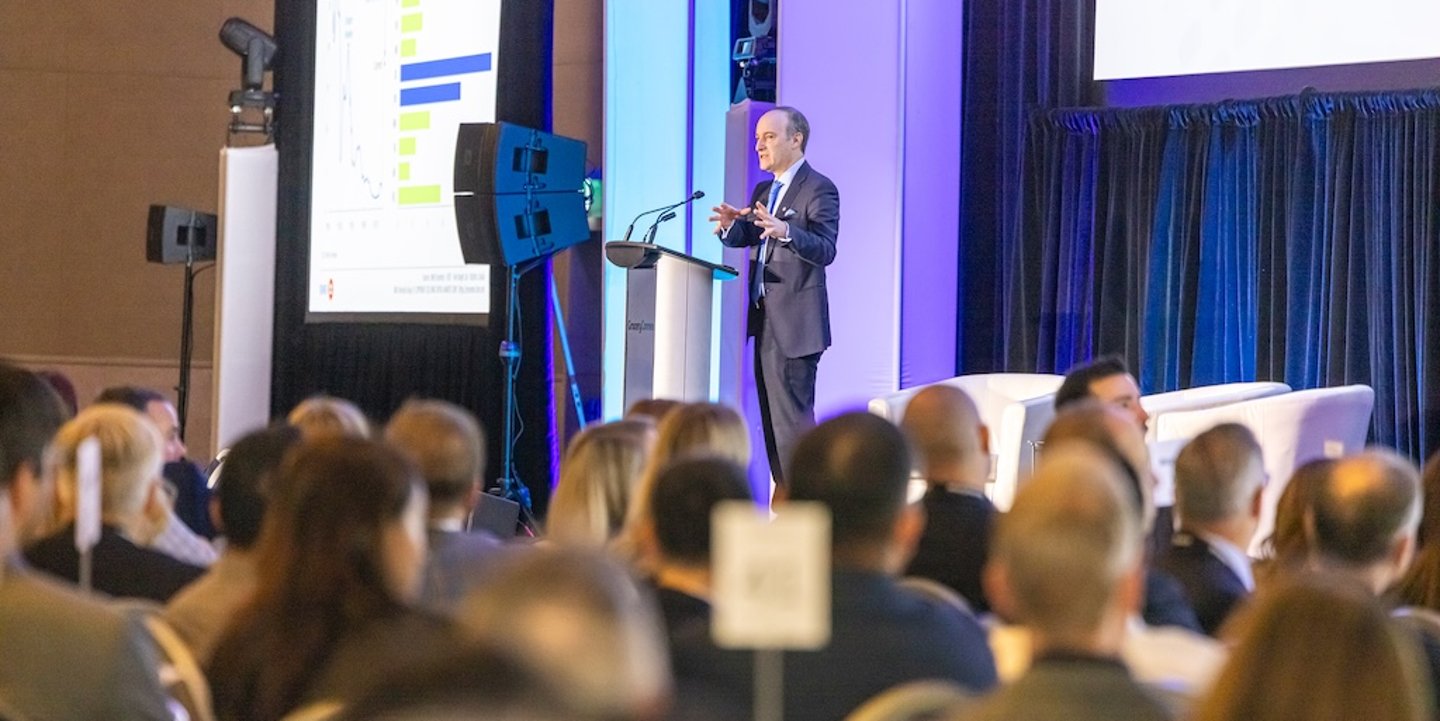
Douglas Porter, chief economist and managing director, BMO Financial Group, took the stage at Canadian Grocer’s GroceryConnex event in Toronto this week to provide insights on the state of Canada’s economy and an outlook into 2026.
“In terms of our 2026 forecast, we are anticipating modest growth at best and for the fourth year in a row, we will see growth a little bit below average,” said Porter.
Trade uncertainties continue to affect Canadian economic growth, while Porter said Budget 2025 is “concerning yet manageable.”
Consumer and business confidence is down while commodity prices, especially metals and energy, show mixed trends, impacting regional growth.
Canada is expected to see a slightly better year for the economy in 2026 and has seen interest rates come down and dollars allocated to infrastructure.
Budget 2025
“This budget may have suffered a little bit from being oversold, with the finance minister saying it would be transformational and the Prime Minister saying it would be generational,” said Porter of the budget. “I think when we look back to all the policy changes that have been passed here in Canada in 2025, we’ll see that there is quite a structural change in the Canadian economy and the budget was part of that.”
Porter noted that Budget 2025 was a serious effort to try and strengthen the economy and to deal with trade uncertainty, however “we cannot accomplish this overnight, it’s something that will take time.”
READ: Liberal budget earmarks billions for 'bold and swift action' to meet U.S. disruption
“There has been a lot of concern over the size of the budget deficit. A year ago, when we last heard the financial update, the goal at the time was to achieve a budget deficit of around $40 billion a year. Now, we’re talking about something close to $80 billion for the current year. This is happening without the economy really deteriorating over the past year,” said Porter.
“I would categorize the current budget deficit as concerning but manageable. I would like to see the deficit come back down in years ahead, presumably as we get through some of this worst trade uncertainty,” said Porter.
Trade and tariffs
The average tariff rate on Canada sits between 6% to 7%, which Porter notes is manageable, considering the possible 25% across the board tariff Canada was facing earlier this year.
“Its still quite a big change from anything else we’ve been dealing with over the last 30 or 40 years,” said Porter. Looking at tariffs from a Canadian point of view, Porter noted each province tells a different story.
Porter explained this is due to who is responsible for paying the tariffs and while there is no clear answer, the costs have been split between three groups.
“Who pays these tariffs comes down to what the product is. For products that don’t face much competition in the United States and that can be produced there, like bananas or coffee, consumers often end up eating more of the tariffs,” said Porter. However, middlemen, like grocers, and foreign producers face their fair share of tariff costs.
READ: Trade uncertainties continue to affect Canadian economic growth
“Central Canada is bearing the brunt of the effect of tariffs, namely due to the aluminum industry in Quebec and the steel and automotive industries in Ontario,” said Porter.
British Columbia follows suit with its lumber industry. The prairie provinces have experienced very little effect. Porter notes this is not because these provinces don’t trade with the United States, but because the goods they are trading don’t face as much competition or strain.
So, how have consumers and businesses been dealing with all of this? Canada saw a sharp decline in both business and consumer confidence this year.
Looking ahead
Porter said it is estimated the economy will grow “a little bit more than 1% this year after inflation.” In a normal year, the Canadian economy usually sees growth of about 2%.
Looking into 2026, Canada is expected to see a slightly better year for the economy, still below average as it will still be dealing with a lot of trade uncertainty. There are some positives—we have seen interest rates come down and the new budget has a lot of dollars allocated to be spent on infrastructure, which will help to support businesses.
“To be clear, because of the trade uncertainty, which is a very big part of our economy, we do think it will be a below average year for next year as well,” said Porter.
“The equity market, while it doesn’t perfectly align with the economy, overtime can be a leading indicator of the economy and the fact that we did record a record high is a hint that the economy might actually do a fair bit better than expected in 2026,” Porter also noted.
In 2026, there is a focus on the review of the United States–Mexico–Canada Agreement (USMCA), which Porter said could turn into a full renegotiation.
“I'm not particularly optimistic on where that's headed. They don't want to see significant changes to it and it may be that it's just kicked down the road to review it again in 2027. That is a very real possibility and disappointment,” said Porter.
Employment
In 2022, Canada had a very strong job market. The jobless rate sat at 5% and there were a million vacant jobs, which equated to more vacant jobs than unemployed Canadians.
“We got too much of a good thing and now the unemployment rate is up by two percentage points and the job market is now weak,” said Porter. “There are now three employed Canadians for every vacant job.”
READ: Labour pains: Canada's job market in flux
When looking into 2026, the unemployment rate is predicted to increase in the coming months, up to 7%. Porter noted that it is not expected to remain this way in 2026, with the unemployment rate expected to taper off in the second half of the year.