M&M Food Market’s Tammy Sadinsky on the company’s “surgical approach” to finding cost-savings for customers

With food prices up 3.4% year over year in July, Canadians were paying a hefty 27.1% more to feed themselves and their families than in July 2020, according to Statistics Canada,
Now, M&M Food Market—which operates more than 320 standalone franchise and corporate owned stores, along with thousands of Express locations nationwide—has indefinitely reduced prices on 150 items in Eastern Canada and 200 in Western Canada.
Canadian Grocer recently spoke with Tammy Sadinsky, the company’s new vice-president, marketing and innovation (she joined M&M in June) about what she calls her team’s “surgical approach” to finding cost savings.
“The team looked closely at what it would take to make prices more affordable. We worked with suppliers in ways to control costs, and we also scrubbed for efficiencies within our own systems,” says Sadinsky. “This allowed us, in some cases, to reduce regular prices.”
For example, the 907-gram lasagna (3 to 4 servings) was slashed from $14.99 to $9.99, a savings of 33%. M&M Food Market has made available a full list of reduced-price items on its website.
READ: Canadians continue to prioritize value at the grocery store
Sadinsky says the specialty frozen food retailer, owned by Western-based fuel and convenience company Parkland since 2022, is also exploring promotions for products that couldn’t be marked down.
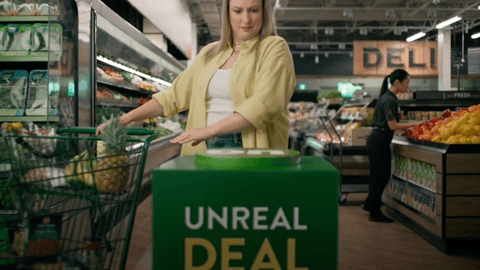
To highlight the savings, M&M launched, at the beginning of September, an integrated campaign that Sadinsky calls “scrappy,” reflecting a lean budget that allows more funds to go toward their pricing strategy.
The campaign runs across connected TV platforms such as Crave, Disney Plus, Amazon Prime and Roku, as well as YouTube and social media. “We’re also making sure customers see the message at the ‘point of truth’—in-store and on our e-commerce site, as well as through e-mail and other CRM tools,” she adds.
M&M Food Market’s move comes at a time when broader government efforts to improve grocery affordability in Canada are still in early stages. The grocery code of conduct that, among other measures, requires grocers to develop and share plans for keeping prices down, had 20 partners as of early July—but only one major retailer, Empire Company Limited, parent of Sobeys and FreshCo.
The code is expected to come into effect on Jan. 1, 2026.
“While the Canadian government’s grocery affordability strategy, encouraging voluntary price reductions has great intentions, its impact has been limited by the lack of full co-operation,” Sadinsky says. “And so, with our initiative, we hope to inspire others. If all the major players in this market took similar steps, it could make a big collective difference for Canadians at large.”
While tightening prices may seem counterintuitive to growth and profitability, Sadinsky sees a “strong business case” for doing so.
“It starts with trying to do right for the customer, and when something’s right for them, they keep coming back. It also drives growth for various suppliers,” she explains. “It’s a different way to look at keeping the business profitable and growing during a challenging time.”
Sadinsky brings nearly three decades of experience in CPG and retail to her role. Seven of those years were spent in the frozen food category at General Mills in Canada and the United States, working on brands including Green Giant and Pillsbury.
Following General Mills, she served as chief marketing officer at Tim Hortons Canada, gaining insight into the franchise business model, and later led marketing at Walmart Canada, focusing on retail execution and driving same-store sales growth. More recently, her role at CIBC added expertise in customer acquisition, CRM and first-party data.
“At M&M, I’m drawing on my experience marketing Canadian flagship brands with long-standing heritage,” Sadinsky says. “And I am also blending my 10 years in retail with 17 years in CPG to bring both perspectives to the business.”