What’s working and what’s next for Canada’s grocery code

The Office of the Grocery Sector Code of Conduct (OGSCC) earlier this week released its Fall 2026 report, its second since the code came into effect at the start of the year.
The office's framework includes a confidential Issue Centre, a Dispute Resolution Management Process (DRMP) and the code itself, which outlines the principles governing commercial relationships between suppliers and retailers.
None of the 216 members used the DRMP during the reporting period, from June 1 to Oct. 31, 2026, as was also found to be the case in the Spring 2026 report. Five additional Issue Centre submissions were recorded, bringing the total to 14 across both reports.
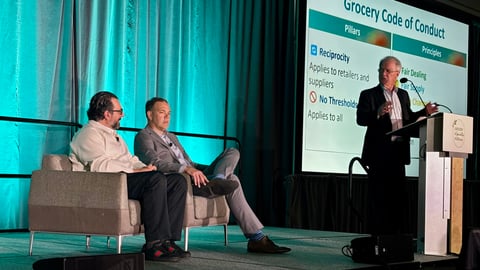
Karen Proud, president and adjudicator of the OGSCC, discusses what the office is hearing from suppliers and retailers, its work on forecasting and fill rates, efforts to expand membership and key priorities for 2027.
The report notes five additional Issue Centre submissions. Are you seeing common themes in those submissions?
They are generally around the same types of issues. What we've really learned is that the Issue Centre, to date, has not been the main avenue for us to receive information about issues suppliers or retailers are having in the marketplace. We said this in our spring report as well.
People seem to be a bit reluctant to use the Issue Centre. Some clearly are doing it, which is fantastic. But because it's a form you fill out, I believe people feel it's almost a formal complaint, versus sending us an email or talking to us at a meeting. That's why I believe the numbers seem a bit low in comparison with all that's going on.
The office has undertaken exploratory work around forecasting, purchasing and fill rates. What prompted that work, and what are you hearing from suppliers and retailers?
I'm out meeting with suppliers and retailers at every opportunity I can. We have one-to-one meetings, meet people at conferences, and have video calls and phone calls. Anyone who's a member has very good access to the office. This is where I'm really hearing about the big systemic issues. Concerns around fill rates and non-compliance charges, more generally, are usually raised through those conversations. People talk about their concerns and the things that cost their businesses a lot of money and cause a lot of angst. Through those conversations, we really dig into what the big issues are that we should be tackling.
The office is examining recurring concerns among members in the fresh fruit and vegetable sector. What are you hearing?
Depending on the product category, there are different issues and concerns at play. If you're talking about fresh fruit and vegetables, understanding what's expected at the beginning of the growing season is pretty important. With another type of product manufactured in a facility, you may have a little more control.
It's different again if the product is imported and you've got lead times to address. If there's an order well above what was forecast, but you need six months' lead time to manufacture or import that product, those sorts of things need to be looked at. That's where we're really trying to understand the various aspects before we talk about how the code should be used in those cases.
The report also references non-compliance fees. How does the office approach those, given there are no fines or penalties for non-compliance with the code itself?
When I mention non-compliance fees, that relates to an industry practice where, if you don't meet your agreement, there may be fees involved. If you're not meeting a certain obligation under your agreement with a supplier or retailer, they may charge you a non-compliance fee. We're looking at guidance around the fairness of those fees.
Listing and non-compliance fees are an important issue for suppliers. Why are they outside the scope of the code?
Those areas were deliberately left out of the code. I didn't draft the code; it was drafted before I came on board. When the industry got together and created it, they specifically did not want it to address pricing and that kind of commercial activity. It's similar to the UK Code; it doesn't go into that either.
We wanted to make note in our report that we have heard these issues being raised, but they don't fall under the code. Part of our responsibility is to report on the effectiveness of the code, but we'll also highlight any areas where we've been hearing ongoing concerns that the code does not address. Should there be a review of the code in the future, we want to continue documenting those areas where we've heard complaints and issues but where we're not able to act.
The office recently finished its first compliance survey. What kind of response did you receive?
It closed on Nov. 6, and we got a very good response. The latest numbers, which are hot off the press, show that about half of our membership responded. That’s close to 100 responses, which is really fantastic.
We're just at the very beginning of the data analysis. We'll have those results sometime before the end of this year, and they'll be published in our first-ever annual report, which is set to be released towards the end of January or beginning of February.
Membership has grown to over 200 organizations, including the major retailers and suppliers. Where would you most like to see further growth?
Small- to medium-sized enterprises, whether they're independent grocers, smaller suppliers or primary producers. That's the group we haven't penetrated as far as I would really like.
Having 200 members is fantastic. We have all the large retailers, which was key, and they came on relatively early. From the supply perspective, if you think of the total volume of products that would fit under the code, we have all the big suppliers for the most part.
But it's those smaller and medium-sized organizations that we really need to encourage to join the code. It's those businesses that stand to gain the greatest value from the code, particularly in their commercial relationships.
We have some work to do in 2027 to drive membership growth by continuing to raise awareness about the code. Part of what we need to do is demonstrate its value. Through these reports, I'm hoping these smaller organizations see how the code is working in practice and can join.
What have you learned about the grocery sector in taking on this role in March?
I've held various roles in the industry over the years, including at Retail Council of Canada and Consumer Health Products Canada. Michael Graydon and I later merged Consumer Health Products Canada with FCPC to create Food, Health & Consumer Products of Canada.
But this role has given me a much deeper understanding of how the sector works. One of my early learnings is just how complex it is. Nothing is cut and dried. There are so many different aspects, from supply chains and marketing to legal considerations. It takes considerable effort to understand how everything works before deciding where and how to act.
It's also a very challenging time for suppliers and retailers. There are so many external factors at play, whether it's tariffs or the cost of inputs. The sector is in the spotlight almost daily because of rising food and grocery prices, and there's a lot of pressure on businesses.