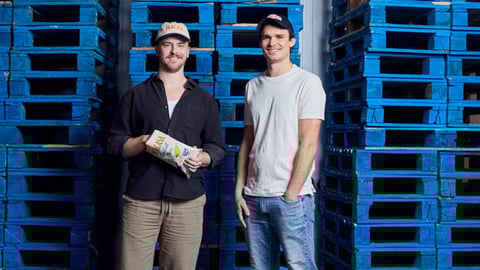
Meet the duo bringing a traditional Indigenous dry meat snack to a national audience
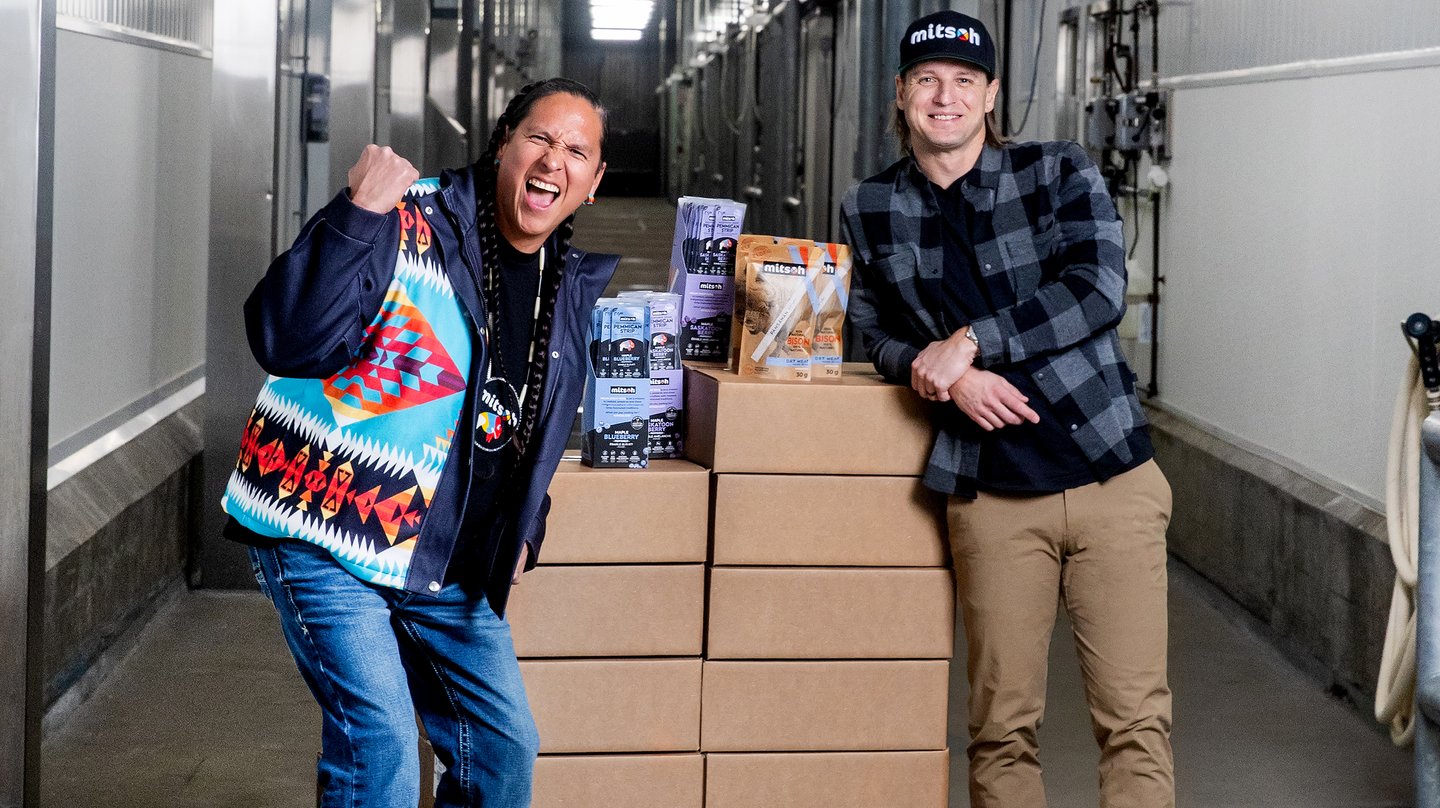
Ian Gladue’s career in food began with childhood imagination. Rather than playing doctor or teacher, Gladue preferred playing “restaurant” with his family. As he got older, that childhood play evolved into genuine experimentation with ingredients and preparing meals for the people around him.
Raised on the Bigstone Cree Nation in Central Alberta, Gladue relocated to Edmonton as a teenager, eventually channelling his culinary passion into a food truck—opened in 2013—serving bannock burgers, a blend of fast food and traditional Indigenous bread. This evolved into the 2015 opening of his Edmonton-based restaurant called Native Delights. Still, Gladue felt there was more he could do. One day, he was spending time with his mother while she was preparing dry meat—a traditional Indigenous food made by slow-smoking thinly sliced meat. “I looked at her and said: ‘That’s it’,” Gladue recalls.
He began preparing dry meat made of bison for customers at Native Delights. “When that started, the dry meat just took off,” says Gladue. “People were coming in just to buy the dry meat and we were selling out as fast as we could make it.” The positive buzz drove interest from River Cree Convenience store on the outskirts of Edmonton as well as Alberta-based grocery chain Freson Bros. and several independent Indigenous gas stations—all wanting to stock Gladue’s shelf-stable dry meat. “It became an overnight success,” he explains.
In 2016, Gladue closed Native Delights to focus on his new dry meat venture. “We pivoted fast and decided to go all in,” he says. He moved production to a commercial kitchen and put all his efforts into operating the company, then known as Pânsâwân, which means “thin-sliced meat” in Cree.
Over the next few years, Gladue was able to maintain the business—the dry meat was stocked in about 35 stores in Alberta—but struggled to grow. “I was capped out,” he says. “I knew I didn’t have the expertise to run the operational side at scale.” Gladue wanted to grow the business and sell his products outside of Alberta, but that meant moving to a federally approved production facility and conquering a new side of the consumer packaged goods industry.
Fortunately, in the spring of 2019, Gladue connected with Brandon Markiw, the owner of a federally inspected food manufacturing operation in Leduc, just south of Edmonton. Markiw, also a founder of an all-natural deli line called Range Road Meat Co., had the expertise that Gladue needed. The two developed a strong bond. “A two-hour tour of the facility turned into a 10-hour hang,” Markiw explains. “Ian’s vision was immediately clear to me.” While he isn’t Indigenous himself, Markiw has a deep respect for Indigenous culture and was keen to help Gladue scale up his operations.
Producing Gladue’s traditional dry meat wasn’t easy. They were taking a food with thousands of years of history—traditionally made outdoors with open fire, wind and sunlight—and making it in a facility. “At the beginning, Ian and I were spending 10 to 12 hours a day in front of the smokehouse, monitoring every step,” explains Markiw.
The pair scored their first major grocery listing in 2019. As part of the Sobeys local program, Gladue’s dry meat products were listed in 30 of the grocer’s Alberta stores. Five months later, the duo’s manufacturing relationship blossomed into more. Gladue formally asked Markiw to join the Indigenous meat snack company as co-CEO. “We did it traditionally with a sweat lodge ceremony and smoking a pipe together,” explains Gladue. “That’s what has bonded us ever since.”
Markiw helped Gladue diversify the product lineup for a national rollout. “We were trying to understand how the story could connect to a wider audience across the country,” Markiw explains. “Dry meat is the most nutrient-dense natural food snack product in existence, but it’s less approachable than the modern meat snack experience.”
What came next was a product innovation from Gladue: pemmican strips—a traditional Indigenous food made by pounding dried meat into a powder and mixing it with fat and other ingredients. Gladue developed his recipe using bison, berries, maple syrup, salt and smoke. The pemmican strips launched in 2023 along with a new brand name: Mitsoh, which means “eat” in Cree. Mitsoh products are now in about 1,000 stores across Canada.
Considering how far he’s come, Gladue feels grateful to be at the helm of a burgeoning Indigenous food business. “It’s a blessing to help contribute and preserve something that was here long before us,” he explains. “To play a small part in that is an honour and a privilege to be able to do that for my people, my children and for the future generations.”
This article was first published in Canadian Grocer’s May 2026 issue.