Sobeys owner Empire to remove some buy Canadian signage
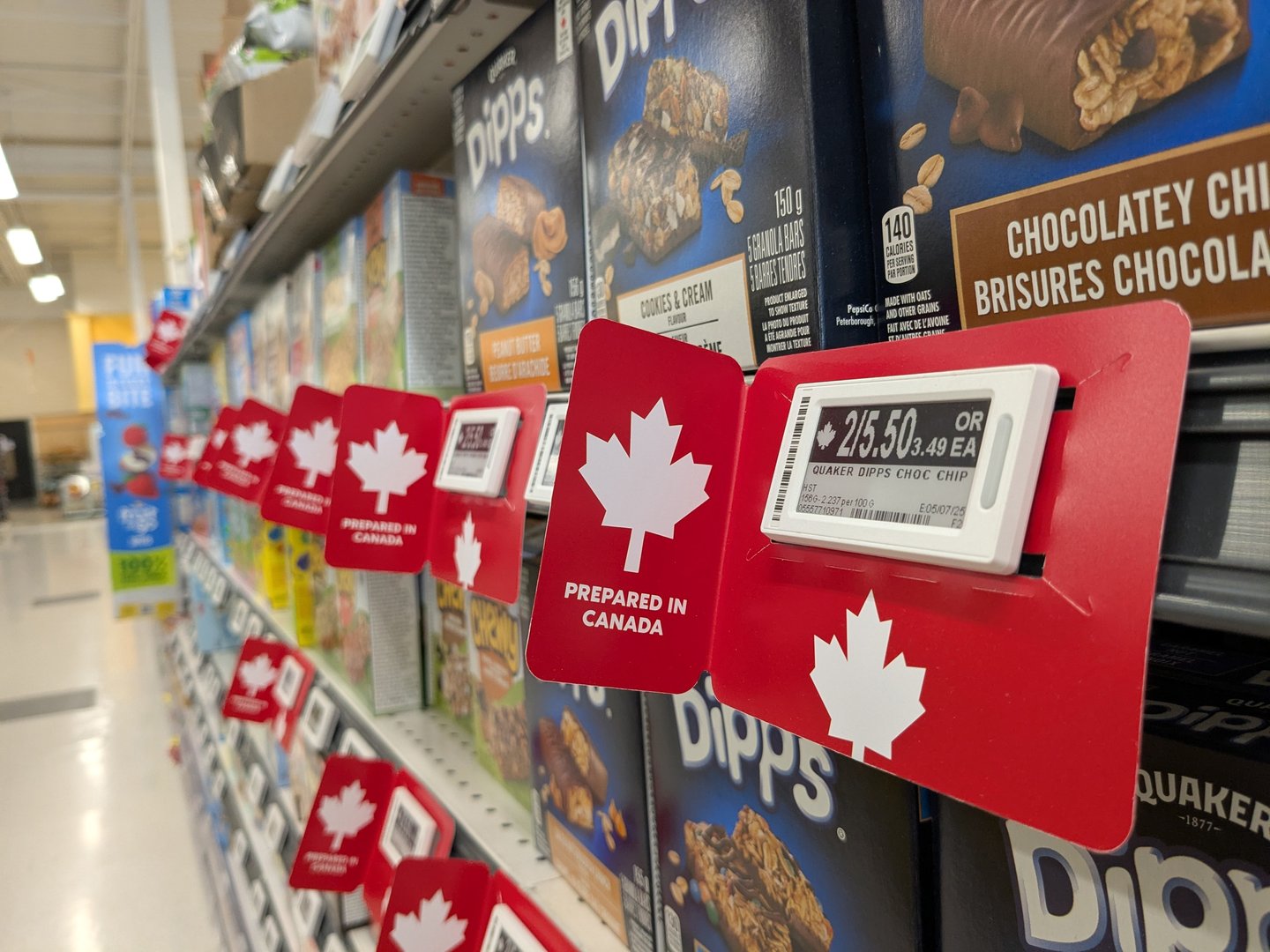
Empire Co. is starting to remove some signage meant to highlight Canadian products from its store shelves.
It comes about a year after major grocers implemented maple leaves and other symbols to signal homegrown products amid a buy Canadian trend that erupted among shoppers.
READ: One year later, 'buy Canadian' sentiment remains strong
Empire said it will continue to stock local products but largely leave it up to customers to determine a product's origin.
"We believe Canadians are, now more than ever, well informed in assessing country of origin when making their purchasing decisions based on package labelling and we are confident that this remains the best source of information for customers," said Luc L’Archevêque, Empire's chief customer officer, in an emailed response.
The buy Canadian wave surged last year as U.S. President Donald Trump’s attacks on trade with Canada and the world led to a litany of economic uncertainty, tariffs and other threats.
As consumers shunned American-made products, grocers responded by shoring up their domestic and international supply chains. Grocers began adding signage to their shelves to more clearly indicate which products had Canadian ties. Loblaw also began marking items that saw price increases due to tariffs with a “T” symbol.
Manufacturers also revamped their packaging to indicate any domestic ties.
Both Metro Inc. and Loblaw Cos. Ltd. told The Canadian Press their buy Canadian signage will continue to remain in place.
"At this time, signage in our stores identifying products as prepared in Canada remains in place," said Loblaw spokesperson Scott Bonikowsky in an emailed response.
READ: Buy Canadian movement at grocers could ramp up again during trade talks
Meanwhile, Metro spokesperson Stephanie Bonk said the company "is not planning on making any changes at this time."
In recent months, grocery executives have noted they've seen the buy Canadian trend starting to lose momentum, with some customers reverting to just purchasing the cheapest option available, regardless of its origin.
“We are seeing some customers who are going back to those products that they love, now that they are much cheaper than they were, and that will have some affect Canadian sales,” Loblaw chief executive Per Bank told analysts during a conference call in November.
Metro's chief executive Eric La Flèche also acknowledged a softening in the buy Canadian movement during an earnings call in November.
"There's still more growth in buy Canadian product sales than non-Canadian product sales, but that growth has somewhat narrowed versus what we saw in spring and summer," he told analysts.
The hype for homegrown products has also waned as high food inflation has taken a toll on household budgets.
"[It's] the reality of increased inflation and consumers having a harder time to make ends meet," said Jo-Ann McArthur, president of Nourish Food Marketing. "A lot of people are saying, 'I can't pay a premium anymore.'"
OPINION: Food patriotism has a price—and most Canadians say they’ll pay it
Statistics Canada reported food inflation in February was up 5.4% from a year ago, far outpacing the overall annual inflation reading of 1.8%.
Many economists are also warning that food inflation could get worse in the coming months as the war in the Middle East puts more pressure on shipping costs.
McArthur speculated Empire's decision to remove some buy Canadian signage could also be related to the Canadian Food Inspection Agency's crackdowns on misleading displays.
"They're just derisking," she said of Empire.
The CFIA levied fines on a few grocery stores, including Loblaw-owned Real Canadian Superstore, earlier this month for "inaccurate and misleading origin claims." The agency said it takes labelling issues seriously.
McArthur said the move to identify Canadian products has been confusing for many people, including some grocery store employees.
"Mistakes are going to happen," she said. "Probably, they're not intending to mislead the consumer, it's just a mistake that's been made — but it's a costly mistake."
McArthur said it's likely that other grocers would follow suit.
"I would be pretty confident that operationally, there's a number of memos going out there, saying, 'thou shall not,'" she said.