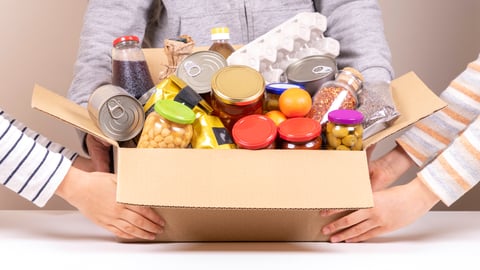
The appeal of the deal: Liquidation grocery stores move into the mainstream

Once viewed as a niche option for cash-strapped shoppers, liquidation grocery stores are increasingly attracting a broader cross-section of Canadians—and raising questions about what the trend means for traditional retailers.
The growth of stores—like Liquidation Marie in Quebec, Grocery Outlet in Ontario and Bianca Amor’s Liquidation Supercentre in British Columbia—reflects a mix of economic pressure, changing consumer values and evolving retailer strategies, said Ramesh Venkat, director of the David Sobey Retailing Centre at Saint Mary’s University in Halifax.
“Even though overall inflation has slowed to about 2.4%, grocery prices continue to climb faster at about 5%,” Venkat said. “People are actively looking for ways to reduce their grocery bills.”
Environmental concerns are also shaping behaviours, he adds.
“Many Canadians, especially younger shoppers, care about food waste. Surplus stores sell products near best-before dates and ‘ugly’ produce that is perfectly edible. That keeps a lot of food out of landfills.”
READ: Planting the seeds: How grocers and CPG brands can lead on sustainability
Larger supermarket chains are responding to these consumer concerns by expanding and offering value through their own discount banners, or by entering into partnerships with surplus stores, Venkat said. “Major grocers have (also) partnered with ‘food rescue’ apps to help consumers access much lower priced grocery items nearing expiry dates.”
Loblaw Cos. Ltd. began its partnership with Flashfood in 2019 and as of 2025, has diverted nearly 86 million pounds of potential food waste from landfills through the program.
In 2024, Empire Company Limited expanded its relationship with Montreal-based food waste app Food Hero, rolling out its program with Sobeys in Ontario, as well as in Atlantic and Western Canada. This is in addition to FoodHero’s reach across Quebec and New Brunswick with IGA, Rachelle-Béry, Marché Tradition and Metro.
Metro Inc. joined Too Good to Go in November 2022, with an initial rollout of 20 stores in the Greater Toronto Area. As of 2025, all of its banners are featured on the app.
A complementary model
At Quebec-based Liquidation Marie, founded about 12 years ago, owner Marieve Breton says the customer base has shifted dramatically in recent years.
She said in the past, the demographic of her stores were typically budget-conscious shoppers.
Now, she says, everybody is coming in, even those who can afford to shop at traditional retailers or premium grocery stores.
"They come because they see it’s the same thing." she said.
Liquidation Marie sources inventory through a variety of channels: cancelled retail orders, export overruns, near-date products and items with labelling or weight irregularities. In some cases, suppliers approach Breton directly with surplus goods they can’t place elsewhere.
“It comes in many ways,” Breton explains. “Sometimes it’s because the weight is not right. Sometimes a retailer removes it from inventory. Sometimes the [expiry] date is too close to sell in conventional grocery stores.”
Rather than seeing her business as direct competition for grocery retailers, Breton describes it as complementary.
“In grocery stores, you find fresh [products], not ones on or nearing their expiration dates,” she said. “That’s why it’s not the same business.”
READ: Research shows best before confusion fuelling food waste—and grocers can help
Changing inventory
Inventory changes daily, creating what Breton likens to a treasure-hunt environment.
“I explain my business like Winners,” she said. “When you go to Winners, you don’t know what you’re going to find. It’s the same thing, but in grocery.”
Produce in particular performs well, she said, pointing to “number two” fruits and vegetables that may not meet cosmetic standards but remain very edible.
Sometimes, that variability means shoppers need to be creative in the kitchen—a challenge many embrace, along with the satisfaction of finding a bargain, she said.
Forecasting strain
The growth of liquidation formats reflects broader supply chain pressures, said Yu Ma, professor of marketing at McGill University.
“The growth of these stores is a direct result of current forecasting inaccuracies,” Ma said. “It suggests traditional retailers are struggling to predict consumer behaviour post-pandemic. Once goods are in the pipe, it’s often cheaper for a brand to liquidate overstock than to pay for warehouse space or reverse logistics.”
Brands are increasingly using secondary markets strategically, he added.
“Instead of seeing liquidation as a failure, they see it as a recovery valve in the current economic situation. They could recoup the cost of raw materials.”
Margin pressures
Ma said liquidation stores attract more than just price-sensitive consumers. “I expect to see both budget-conscious and eco-conscious consumers,” he said. “Also the treasure hunters.”
A potential downside for the broader market is eroding margins.
“When a consumer buys a bottle of olive oil for $10 at a liquidator, they may mentally anchor to that price,” Ma said. “It becomes a reference point. This can lead to a wait-for-sale mentality, which erodes the margins of traditional retailers and makes it harder for high-quality producers to survive.”
Still, liquidation formats don’t necessarily force traditional grocers to slash prices across the board.
“Because liquidation inventory is inconsistent—here today, gone tomorrow—traditional grocers still hold the advantage of reliability,” Ma noted. “Retailers also usually run loss leader promotions to keep foot traffic.”
Nonetheless, liquidation grocery stores are likely here to stay.
READ: Food prices forecast to climb up to 6% in 2026
“Consumer behaviour has shifted. People are more value-focused now,” Venkat said. “Food inflation and cost-of-living pressures aren’t going away soon. That will make surplus retail a viable model for quite some time.”