Consumer focus on protein, digestion and health is reshaping the dairy aisle
Dairy products have long been a staple for consumers. But growing interest in functional health—alongside social media trends ranging from protein hacks to butter boards—is reshaping demand and driving innovation in the category.
“I like to say dairy is not on trend, but consumer trends have come to dairy,” says John Crawford, senior vice-president, client insights–dairy at Circana, a global market research firm. “In my opinion, dairy should have been on trend forever with all the attributes various products have: high protein, low sugar, lactose free, whole fat, extended shelf life—all those things are still in play.”
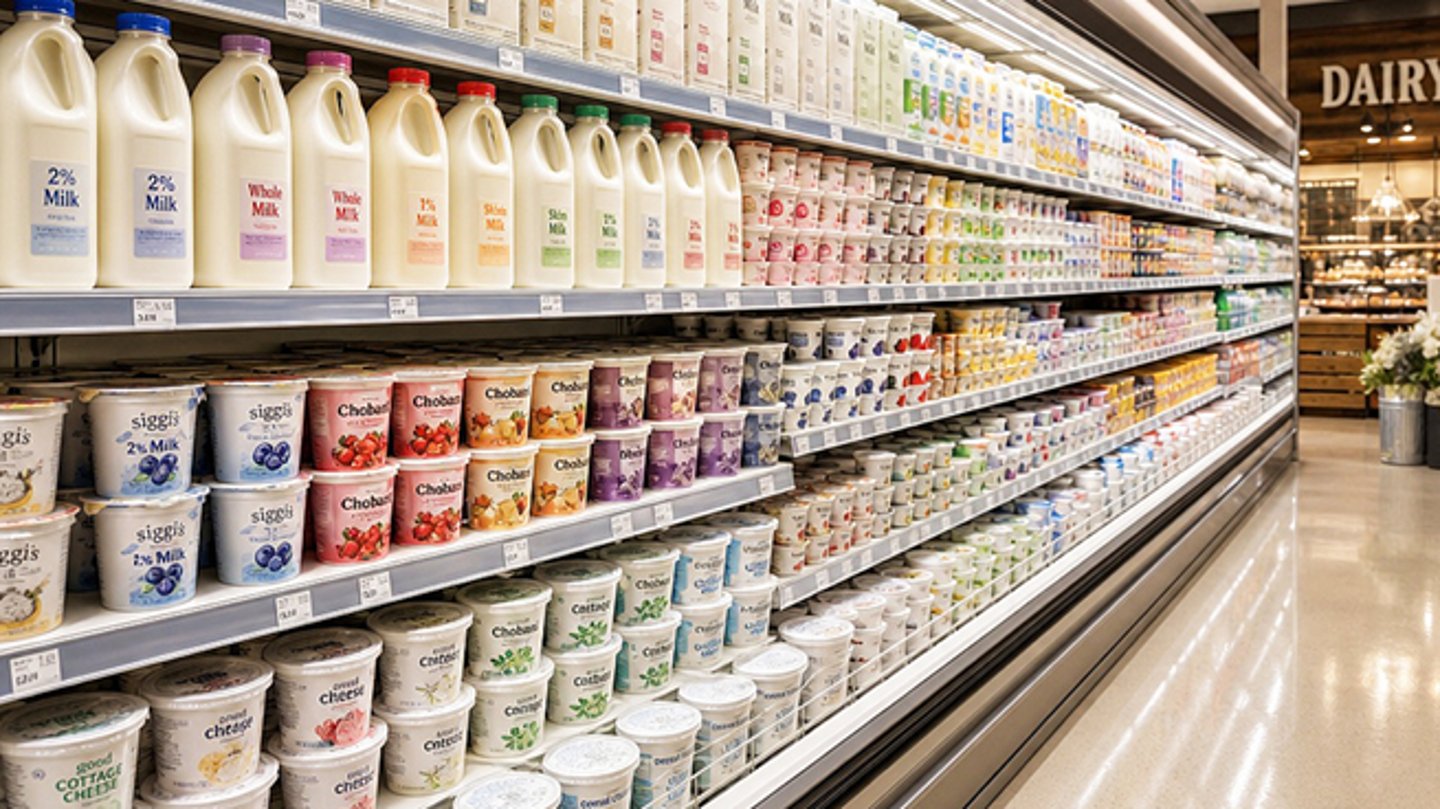
This year, the Canadian dairy market is projected to reach US$16.9 billion, rising to $21.4 billion by 2031, according to Mordor Intelligence. Growth is being fuelled by rising demand for functional and clean-label products, alongside lactose-free and digestive-friendly options. As consumer preferences shift, grocers and manufacturers are expanding their assortments and bringing fresh momentum to the dairy aisle. Here’s a look at the key trends shaping the category.
High protein, low sugar gives milk a lift
After years of sales declines, milk is having a moment. “Consumers never really left dairy. They left milk,” says Crawford. Today, manufacturers are repositioning milk with high-protein, lower-sugar options, which Crawford says is a key trend across the dairy category. “[Milk] brands have done a nice job of rebounding,” he says.
New research from Mintel shows low sugar is the top attribute Canadian consumers now look for in dairy milk and plant-based alternatives, followed by protein. “Functional benefits generally resonate with younger generations, with added protein being strongest among gen Z and second strongest among millennials,” says Joel Gregoire, associate director, food and drink at Mintel.
At Lactalis Canada, the ultra-filtered milk category is experiencing double-digit growth as consumers trade up from traditional milk—and protein is the main driver of this shift, says Kelly Backer, senior director, marketing/innovation, fluid division at Lactalis Canada. “Consumers are actively seeking higher-protein, lower-sugar options as part of their everyday nutrition,” Backer says, pointing to Lactantia UltraPūr, which has 20 grams of protein per serving and no added sugar, as an example.
READ: Lactalis Canada signs deal to buy Agropur's fine cheese business
Agropur, which produces Natrel Plus, sees no signs of this trend slowing down. The lactose-free product contains 18 grams of protein per serving, while the white milk variety contains no added sugar, vanilla and chocolate contain 50% less sugar than regular chocolate milk.
“Protein-enriched is definitely the strongest trend we’re seeing,” says Claudia Joanis, president, fresh products at Agropur. “We see the protein-enriched and lactose-free milk segments taking as much as 20% of total milk consumption moving forward.”
When it comes to protein, Joanis says there are a few consumer behaviours behind the trend: an aging population, functional nutrition and the rise of the GLP-1 medications. While manufacturers are adding protein to products across categories, from breads to snacks, Joanis says dairy remains one of the most accessible and natural sources.
Easier-to-digest options
Digestibility is an increasingly important consideration in dairy, especially as functional benefits are added to these products. “Protein can be tough to digest, so manufacturers need to think about that as well,” says Mintel’s Gregoire.
Agropur has done that by using ultra-filtered milk in Natrel Plus to make it lactose free. This is also a focus at Lactalis. “Digestibility and tolerance are also increasingly important,” says Backer. “The lactose-free segment continues to grow as more consumers look for dairy options that fit their lifestyle without compromising on taste. Lactantia Lactose Free milk delivers the same great taste and nutrition as regular milk, making it easier for Canadians to continue enjoying dairy.”
READ: Yogurt’s popularity continues to climb
Ran Goel, CEO of online grocer Mama Earth Organics, observes consumer demand for high-protein, lactose-free options is shifting purchase behaviours. “We’ve seen some customers who previously b ought plant-bas ed dair y products—whether it’s milk or yogurt— increasingly ask for lactose-free options,” he says. “For some, [lactose intolerance] was the reason they were moving away from animal-based dairy.” While plantbased options are still a big piece of the category, Goel says, “animal-based dairy has had a bit of a resurgence.”
Denninger’s, a specialty grocer based in Hamilton, Ont., is seeing success with a less common variety of cow’s milk: A2 milk from Summit Station Dairy. All the milk from the Hamilton farm comes from its own A2 cows, which naturally produce only A2 protein. Some studies have shown this type of milk is easier to digest than milk from cows that produce both A1 and A2 proteins. “A2 milk is becoming a major trend in Ontario,” says Nathalie Coutayar, the grocer’s merchandising and marketing senior manager.
Fun and better-for-you indulgence still matters
In the yogurt category, the high-protein trend continues to dominate. But, alongside health benefits, there’s still room for a bit of fun. Lactalis Canada recently launched iÖGO Nanö Bubbles featuring a playful bubble texture in a smooth yogurt. Available in three flavours—Orange Cream with Mango Bubbles, Mixed Berries with Strawberry Bubbles and Banana with Mango Bubbles—the line introduces kids six to 12 to the rising popularity of bubble tea textures, says Sabrina Zollo, vice-president of marketing–yogurt & cultured division at Lactalis Canada.
Another recent launch was IÖGO Nanö pouches, a smooth and creamy yogurt in a convenient small pouch, available in Strawberry Banana and Mango. All Nanö products are made with 100% Canadian milk, real fruit and no artificial colours, flavours or sweeteners.
“This has helped drive significant recent momentum in the kids’ segment, as parents look for products that balance fun, nutrition and ease of use for on-the-go occasions,” explains Zollo.
Indulgence is still very much in play, but with a focus on “better-for-you” dairy treats. “Consumers are increasingly looking for permissible indulgence—products that deliver on taste and experience without compromising on quality or ingredients,” says Zollo.
At Lactalis Canada, that’s fuelling growth in premium dessert-style dairy, such as Krema yogurts and Marie Morin, a line of desserts including crème brûlée, chocolate mousse and cheesecakes in individual glass jars. Zollo says these brands cater to the desire for everyday indulgence with a more natural or artisanal positioning. “Dairy indulgence is also driving growth as it caters to new day parts beyond breakfast—afternoon snacking and a post dinner sweet,” she says.
In the United States, Circana’s Crawford points to a new ice cream product called Protein Pints, which contain 30 grams of protein per pint and 85% less sugar than traditional ice cream.
“Flavour is still really important in many of these categories,” he says. “But in some categories, it’s about how clean your label is, what’s the benefit and whether it’s worth the indulgence. That’s where consumers are making their tradeoffs right now.”
Dairy gets cooking
Dairy innovation is also being shaped by what’s cooking in the kitchen. Agropur recently launched Sealtest 6% milk—a first for Canada. Targeted towards the South Asian community, the higher-fat milk is positioned as an ingredient for cooking or to add to hot beverages such as chai lattes and teas. “High-fat-content products are available in other markets today, such as the United States. They were just not present in Canada,” says Agropur’s Joanis. “[Sealtest 6% milk] is very much targeted to the cooking that we see happening with milk.”
Among home cooks, butter is also levelling up with Toronto -based company Whipdd bringing flavour to the commodity category. Co-founder and chef-turned-entrepreneur Shruti Priya Agarwal identified a gap in the market when she moved to Canada from India in 2022. “When visiting grocery stores, I never saw any major innovation in the butter space, and butter for chefs is liquid gold,” she says.
Just a year later, Whipdd launched a small range of compound butters. Today, its Herb & Garlic and Chilli & Lime flavours are sold in more than 200 stores across the country. It recently launched in Healthy Planet stores in Ontario and is expanding into Farm Boy in August. The products are targeted at busy professionals who want to cook at home but don’t want to spend too much time in the kitchen, parents with children looking for more variety and simple preparation, and food enthusiasts who want to recreate restaurant-style experiences at home.
“If you’re making a steak, you don’t need to chop the garlic and buy different herbs—you can take a spoonful of Whipdd butter and toss it in the pan,” says Priya Agarwal. “Soup can be bland, but adding chili butter can give it a little kick. And when you’re sautéing vegetables, a spoonful adds a lot of flavour to your meal.”
This fall, Whipdd is bringing back Honey Cinnamon (one of the original product launches) and is looking to launch Truffle, Maple and Blueberry varieties in the future. “We want to expand and bring a lot more innovation into dairy,” says Priya Agarwal, adding that dairy itself is building momentum.
“Previously, dairy was villainized as something that is not good for you. But people are coming back to good fat.” She points to social media trends such as butter boards as well as restaurants that are serving compound butter. “Everyone is loving butter and they’re coming back to it.”
While cheese has long been a focal point of cooking, it’s also having a moment. “Three in four Canadians [75%] are eating out less often due to the rising cost of living, driving a major shift toward cooking at home to save money,” notes Ola Machnowski, vice-president of marketing–cheese & tablespreads division at Lactalis Canada. “Additionally, Canadians are increasingly looking for ways to level up their everyday meals and bring a sense of discovery to their home cooking.”
To that end, Lactalis Canada recently launched Cracker Barrel Signature, designed to bring “elevated taste and texture to meals and entertaining occasions,” says Machnowski. The line features a variety of block cheeses such as Gouda, Havarti and Aged Cheddar; gourmet shreds such as Smoked Aged & Medium Cheddar and Extra Old & Mozza; and slices such as Monterey Jack with Jalapeño Pepper. Similarly, P’tit Québec Mozzarellaaaaah Gourmet! was developed to bring the standout melt and stretch typically found in professional pizzerias to the home kitchen.
Cottage cheese—the next frontier
The next wave of dairy innovation will happen in the cottage cheese category. Over the past few years, viral recipes have incorporated cottage cheese into everything from soups to smoothies to add a protein boost. “Consumers started to think about cottage cheese differently. Before it was diet food. It was grandma’s food,” says Circana’s Crawford. However, new usage occasions that exploded on social media “really resonated with consumers and cottage cheese has been growing double digits in both dollars and volume for three straight years.”
And that, Crawford points out, is without much innovation in the category and cottage cheese being in short supply amid high demand. “Dairy manufacturers were not ready for this,” he says.
Today, some manufacturers are expanding capacity at their plants to meet demand. “I do think we’re going to start to see more innovation,” says Crawford. That’s already happening in the United States, where Dairy Farmers of America recently launched a higher-protein cottage cheese called MULU, which is exclusive to Walmart. Earlier this year, Etelka launched Cottage Cream, billed as a “smoother, more indulgent alternative to cottage cheese.”
In Canada, Agropur’s Joanis agrees there has been a limited amount of innovation in the cottage cheese category. However, Agropur is making moves. The company recently announced plans to invest close to $1 billion in its Beauceville, Que. and Bedford, N.S. plants, which will include building capacity for its cottage cheese products.
“Capacity is the beginning of it. Right now, we’re not even able to fulfil basic consumer demand for cottage cheese,” says Joanis. She also hints at new cottage cheese products coming out next year. “While we are investing in capacity, we’re always making sure that we equip ourselves for the future.”
This article was first published in Canadian Grocer’s June/July 2026 issue.