
Have you eaten halal meat without knowing it?

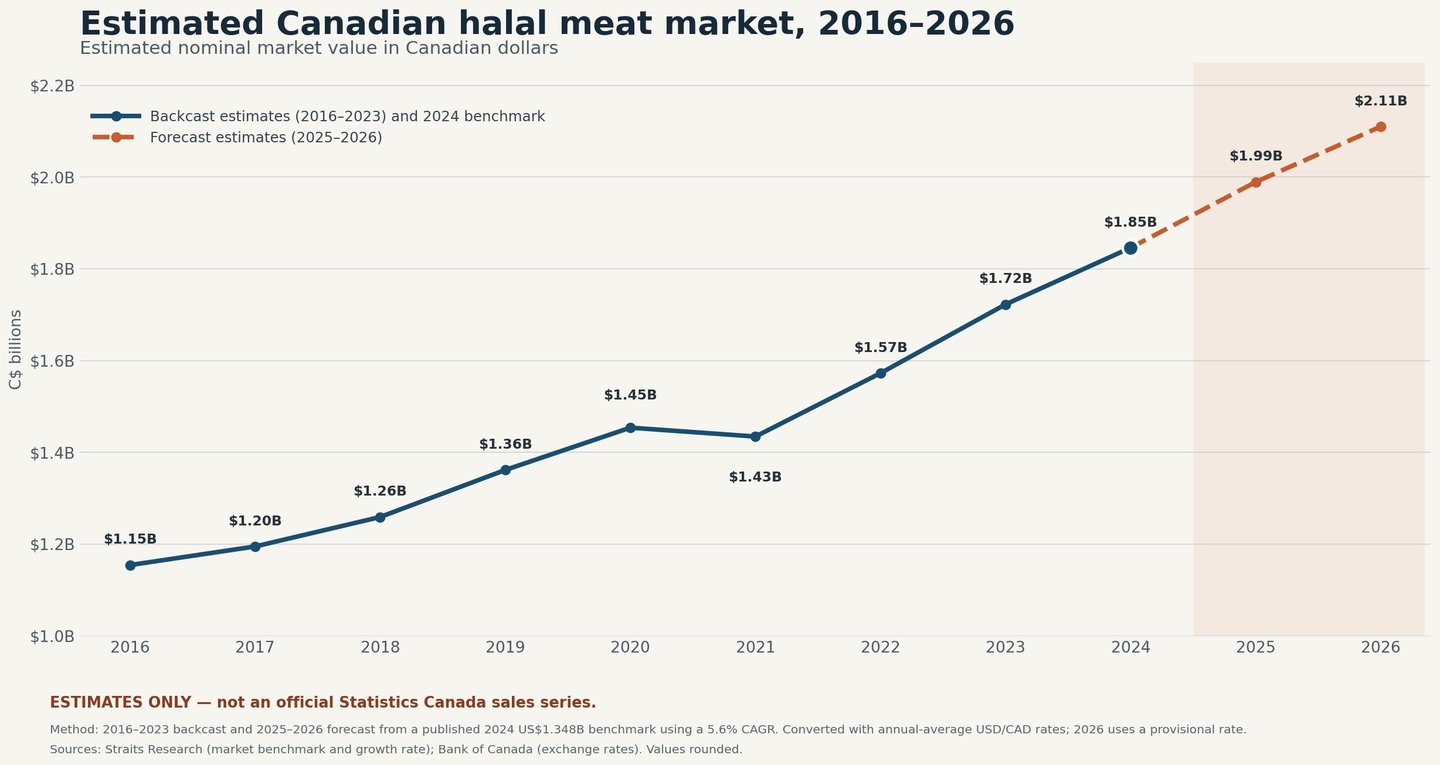
Halal meat is no longer a niche product in Canada. It is sold by major grocers, restaurant chains, independent butchers and institutional food-service providers. Canada’s halal meat market is estimated to be worth roughly $2 billion annually, supported by a Muslim population that numbered nearly 1.8 million in the 2021 census and has continued to grow.
That $2-billion figure is an estimate. Statistics Canada does not publish a comprehensive series tracking halal meat production or sales—an important data gap for a market of this size.
The market’s expansion is a legitimate response to Canada’s changing demographics. But it has also exposed a transparency problem that policymakers and the food industry have largely ignored.
READ: Halal food industry growing to meet demand as Muslim population continues rising
Some retailers and restaurant chains now sell chicken that is exclusively halal-certified and labelled. This is not necessarily the result of religious advocacy or social policy. In many cases, it simply reflects the unforgiving economics of modern food processing.
Large poultry plants are highly automated, capital-intensive operations built for volume and uniformity. Maintaining separate halal and conventional production streams can require additional labour, scheduling, storage, sanitation and traceability. For some processors, operating two systems is simply not economically feasible.
A single halal-certified production stream can serve both the halal market and most consumers who do not seek religious certification. A conventional stream cannot serve consumers who require halal certification. From a processor’s perspective, standardizing production under a halal protocol expands the addressable market while controlling costs.
It is a rational business decision. The complication is that the same production system may supply customers whose products are not ultimately marketed as halal. Some Canadians may therefore be consuming meat produced under a halal-certified protocol without knowing it. That is where legitimate questions about transparency begin.
Federal regulations require that whenever a food is represented as halal, the complete name of the person or organization that certified it must appear on the label, package, advertisement or point of sale. Companies are not generally required, however, to disclose halal certification when they make no halal claim.
In other words, the rules govern what companies say about halal products, not necessarily what they leave unsaid.
This does not mean that all Canadian meat is halal. It is not. Nor does halal certification alter the nutritional value of meat or exempt producers from Canadian food-safety and animal-welfare requirements. Consuming halal-certified meat also does not amount to participating in a religious observance. Still, transparency matters.
Consumers may hold ethical, religious or personal views about slaughter and processing methods. Muslim families may want assurance that a product meets the standards of a certifier they recognize. Other consumers may care about stunning practices or simply expect to know how their food was produced.
The issue becomes especially sensitive in publicly funded schools, childcare centres and other institutions. Serving one type of meat may simplify procurement, accommodate more children and reduce costs and food waste. Those are legitimate operational considerations. But efficiency should not become a substitute for disclosure.
Quebec’s legislation now requires covered public institutions that offer a diet founded on a religious precept or tradition to provide an equivalent option that is not based on such a precept or tradition. Yet an institution could still purchase meat from a halal-certified supplier without explicitly presenting its menu as halal. Administrators themselves may not know how the meat was processed if distributors do not provide that information.
The solution should avoid both secrecy and unnecessary polarization. Halal meat is a food-market issue before it is a culture-war issue, and it should be managed accordingly.
Processors should disclose certification status to commercial and institutional buyers, even when the final product will not carry a halal claim. Retailers and restaurant chains that sell only halal-certified meat within a category should communicate that policy clearly. Public institutions should publish basic sourcing information and provide a reasonable alternative—such as a vegetarian option—when maintaining two meat supplies would be impractical or prohibitively expensive.
Canada also needs greater consistency among halal certifiers. Government should not define religious doctrine, but it can demand credible auditing, traceability and accessible standards. Consumers should be able to determine whether certification permits stunning, whether slaughter is manual or mechanical, and which stages of the supply chain are covered.
Finally, governments need better data. Canada still lacks national statistics showing how much meat is processed through halal-certified systems, how much is explicitly labelled halal and how much enters conventional retail or food-service channels without a halal claim. Public debate cannot be grounded in evidence when the evidence is not collected.
Halal meat is not a threat to Canada’s food system. Opacity is. Clear disclosure, credible certification and practical alternatives would protect religious inclusion, affordability and consumer choice without imposing unnecessary costs on processors.
That is the balance Canada should pursue.