
Ottawa cuts taxes at the pump, then adds them to the grocery bill

Ottawa’s decision to extend the federal fuel-tax suspension just days before a new round of counter-tariffs takes effect suggests that the government has finally done its homework on affordability.
The federal excise tax will remain suspended until January 31, 2027, saving motorists 10 cents per litre on gasoline and four cents per litre on diesel. It will return at half its normal rate for February and March before being fully restored in April. For the food sector, the diesel measure is particularly important. Almost everything Canadians eat spends time on a truck, while farmers, processors, wholesalers and retailers all depend heavily on energy.
READ: Grocery inflation decelerates in July as fresh fruit prices rise 6.1%
The timing is no coincidence. On September 8, Canada will impose counter-tariffs of 15, 25% and 50% on $27.6 billion worth of American goods. By extending fuel-tax relief, Ottawa is effectively removing one source of inflationary pressure just as it introduces another.
That is more coherent than what Canadians witnessed last year.
On March 4, 2025, the Trudeau government imposed 25% counter-tariffs on selected American foods and other consumer goods. At the time, our Agri-Food Analytics Lab was among the very few voices warning that these tariffs would ultimately function as a tax on Canadians.
Tariffs are collected at the border, but their economic cost rarely stays there. Importers may initially absorb part of the increase, but over time the burden travels through distributors, processors and retailers before reaching consumers. Domestic suppliers may also raise their prices when competing American products become more expensive.
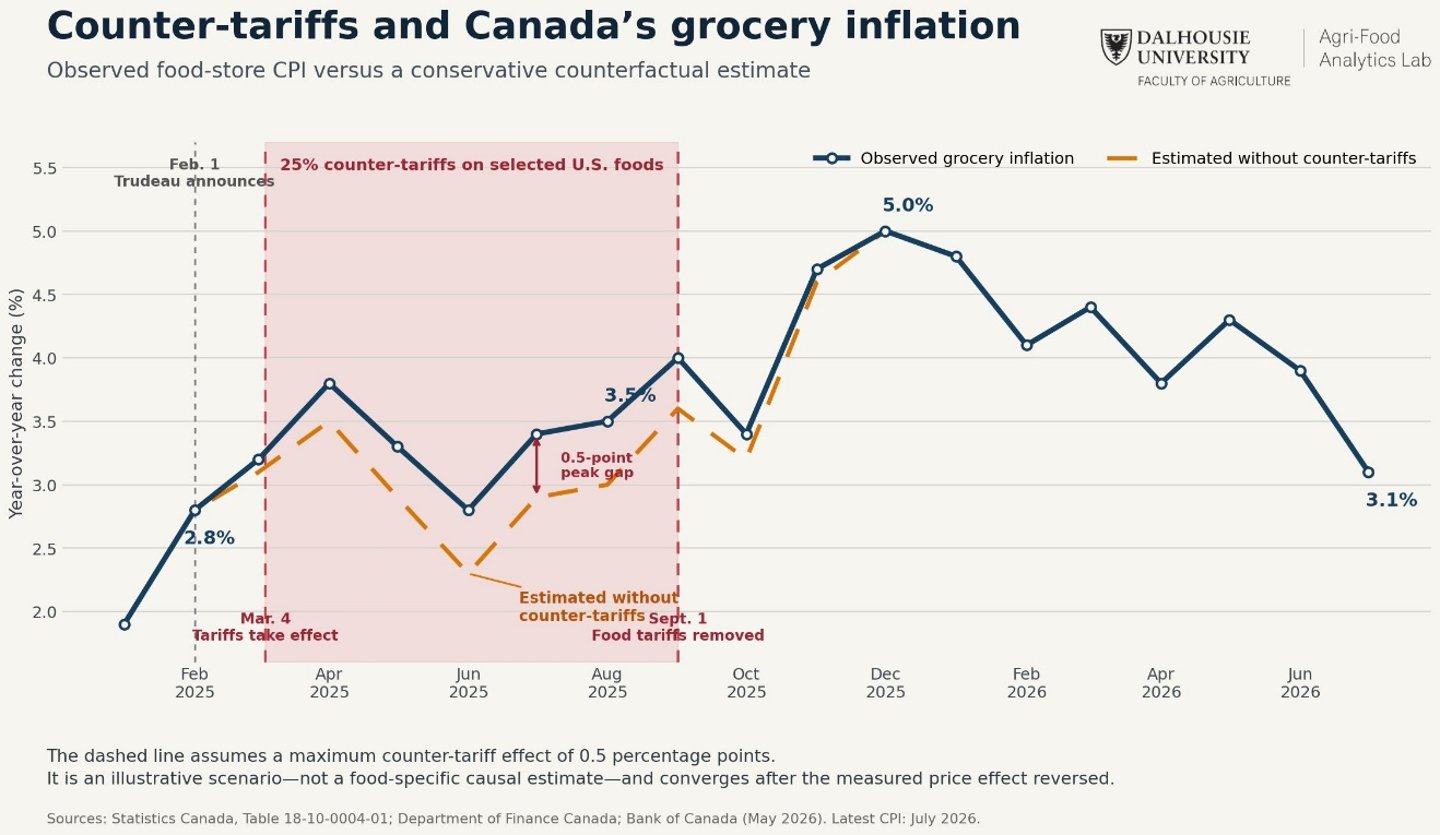
The accompanying grocery-inflation chart illustrates what followed. Food inflation stood at 2.8% when the counter-tariffs were announced in February 2025. After the tariffs took effect, grocery inflation rose to 3.8% in April. It fluctuated during the summer before reaching 4% in September and eventually peaking at 5% in December.
The chart’s dashed line presents a conservative scenario of what grocery inflation might have looked like without the counter-tariffs. It assumes a maximum difference of 0.5 percentage points. This is an illustrative counterfactual, not a claim that tariffs alone caused every movement in food prices. Exchange rates, commodity markets, labour, transportation and weather all mattered.
But the broader conclusion is no longer seriously debatable. Subsequent Bank of Canada research found that approximately one-quarter of the 2025 counter-tariffs was passed through to retail prices. Tariffed products became roughly 6% more expensive relative to comparable untariffed goods, adding about 0.3 percentage points to overall consumer inflation. When most counter-tariffs were removed on September 1, prices moved back toward those of comparable products fairly quickly.
In other words, Canadians paid part of Ottawa’s retaliation bill. Our warning was not ideological; it was Economics 101.
This matters even more when viewed against Canada’s deteriorating food-security performance.
The second chart compares the prevalence of moderate or severe food insecurity among 14 G20 countries for which comparable data were available. Between 2017–2019 and 2023–2025, Canada’s rate more than doubled, rising from 5.1% to 10.5%.
READ: Loblaw reinstates ‘T’ symbol as Canada-U.S. trade war escalates
Canada moved from having the 11th-highest food-insecurity rate in that group to the sixth-highest—a deterioration of five ranking positions, the largest adverse shift among the countries compared. A country that considers itself an agricultural powerhouse should not be moving backward this quickly on access to food.
Food insecurity is primarily an income problem, but food prices determine how far limited household incomes can stretch. For a comfortable household, another dollar on a grocery bill is an irritation. For a vulnerable household, it can mean buying less protein, skipping fresh produce or missing a meal.
That is why retaliatory trade policy cannot be designed solely to produce applause at a press conference. Every tariff must be evaluated according to who will ultimately pay it.
This time, Ottawa’s response appears more surgical. The new list is concentrated largely in industrial sectors such as steel, aluminum, furniture, appliances, agricultural equipment, pulp and paper, and electronics. Within the food category, much of the exposure involves ingredients and inputs—including milk powders, whey, milk proteins, molasses and baking preparations—rather than a sweeping range of supermarket products. Certain packaging materials are also included.
There are exceptions. Imported American cheese and honey, for example, could become noticeably more expensive. Food manufacturers using tariffed ingredients or packaging may also face higher costs. Those increases could eventually reach consumers, especially if tariffs remain in place long enough for inventories and existing contracts to expire.
Still, the overall grocery impact should be considerably smaller than it was in 2025. The list is more focused, alternatives exist for many targeted goods, and the continuation of diesel-tax relief will partially offset transportation costs across the food supply chain.
Ottawa deserves credit for recognizing that retaliation and affordability cannot be treated as separate files. But relief at the pump does not make counter-tariffs free. It merely reduces some of the collateral damage.
Canada can defend its economic interests without pretending that tariffs are paid exclusively by Americans. They are taxes, and taxes change costs, behaviour and prices.
Last year offered an expensive lesson. This year, at least, Ottawa appears to have learned something from it.