
Ottawa wants $1 trillion in investment, but agri-food is starving for capital

The Canada Investment Summit in Toronto was a good idea. It was an overdue one, frankly.
At a time when global capital is becoming more selective and the country’s economic relationship with the United States is increasingly unpredictable, Ottawa is right to bring major investors, Canadian executives and public-sector leaders into the same room. Canada cannot diversify its trade without first expanding its productive capacity.
The federal government wants to catalyze $1 trillion in investment over the next five years. The summit highlighted opportunities in energy, critical minerals, artificial intelligence, defence, transportation and other major infrastructure projects. These are all important sectors, and Canada urgently needs more capital deployed into productive assets. According to Ottawa, 27 nation-building initiatives already represent more than $192 billion in potential investment.
But amid all the talk about what Canada has that the world wants, one strategic sector received remarkably little attention: agri-food. That omission is difficult to justify.
Food and beverage manufacturing is Canada’s largest manufacturing employer, supporting roughly 318,000 jobs. It connects our farms to domestic consumers and global markets. It is also central to food security, regional development, trade diversification and affordability.
Yet Canada continues to treat agri-food as a social or agricultural file rather than as a major industrial investment opportunity.
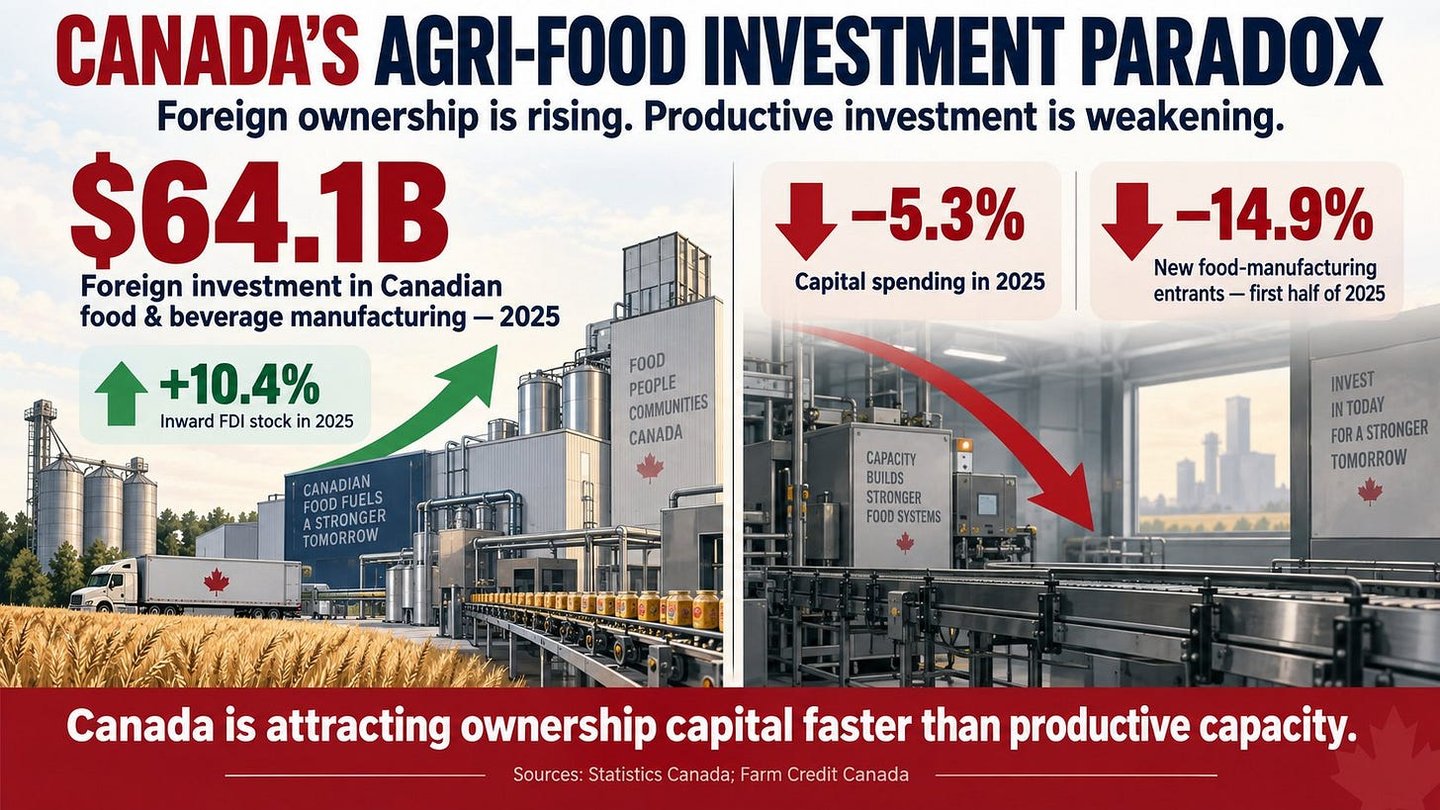
The numbers reveal an uncomfortable paradox. Foreign direct investment stock in Canadian food and beverage manufacturing reached approximately $64.1 billion in 2025, an increase of 10.4%. On the surface, that appears encouraging. More foreign capital should mean more confidence in Canada. But capital spending in the sector fell by 5.3% that same year. Meanwhile, the number of new food-manufacturing entrants reportedly declined by 14.9% during the first half of 2025.
READ: Productivity gains in food and beverage manufacturing sector could unlock $40B, report says
Foreign ownership is increasing while productive investment is weakening.
That distinction matters. Foreign direct investment can enter Canada through the construction of a new plant, the expansion of an existing facility or the installation of more efficient equipment. But it can also arrive through a merger or acquisition in which an existing Canadian company simply changes hands.
Both transactions may count as investment. Only one necessarily expands the country’s productive capacity. Canada does not merely need new owners. It needs new plants.
We need concrete poured, equipment installed, production lines modernized and workers hired. We need more domestic processing of Canadian crops, livestock and seafood. We need cold-storage facilities, ingredient plants, greenhouses, distribution hubs and export terminals.
In short, we need shovels in the ground, not just companies changing hands.
The summit’s focus on energy and infrastructure could certainly benefit agri-food indirectly. Food manufacturing is energy-intensive. Farmers and processors depend on reliable electricity, natural gas, transportation networks, ports, railways, water systems and broadband infrastructure. Investments that reduce logistical bottlenecks or improve access to affordable energy can strengthen the entire food supply chain.
But indirect benefits are not an agri-food investment strategy.
Our processing deficit remains one of the weakest links in Canada’s food economy. Too many Canadian agricultural commodities are exported in a relatively unprocessed form, only for this country to import higher-value finished products. We produce the raw material but allow much of the processing, intellectual property, branding and employment to occur elsewhere.
That is not diversification. It is value leakage. Farm Credit Canada has warned that sustained declines in capital spending could limit productivity growth, constrain capacity and slow the adoption of new technologies. Its latest outlook also projects a fourth consecutive annual decline in food and beverage manufacturing volumes. Revenues may rise, but largely because of higher prices, not because processors are producing and selling more. FCC also estimates that achieving 3% annual growth in the sector could add as much as $40 billion to the economy and create 217,000 jobs over a decade.
Ottawa’s new $1-billion Agri-food Project Finance Fund is therefore a positive step. It recognizes that many strategically important processing projects are too complex or risky for conventional financing. But the fund should be the beginning of a serious agri-food industrial strategy, not the government’s closing argument.
Canada should develop a national pipeline of investment-ready agri-food projects and promote it internationally with the same intensity applied to energy, minerals and technology. That pipeline should identify where Canada has the greatest processing gaps, including fruits and vegetables, dairy ingredients, seafood, plant proteins, greenhouse production and specialized food manufacturing.
Governments should also measure investment success differently. Announcing a large dollar figure is not enough. Ottawa should distinguish between acquisitions and genuine greenfield investment. Canadians deserve to know how much foreign capital is creating new capacity, improving productivity and generating new employment rather than merely transferring ownership.
Regulatory approval timelines must also become more predictable. A food plant can face years of negotiations involving zoning, environmental assessments, water access, wastewater treatment, labour availability and multiple layers of government. Investors will not wait indefinitely while other countries offer ready-to-build industrial sites and faster decisions.
Finally, investment policy must be tied to productivity. Tax incentives and public financing should favour projects that automate production, increase Canadian processing capacity, commercialize domestic innovation or create access to new export markets.
Food security is ultimately a question of capacity. A country that cannot economically process, store and distribute what it produces is not as food-secure as it believes.
The Toronto summit sent an important message: Canada is open for investment. Now Ottawa must ensure that agri-food is clearly visible in the shop window.