
Rising oil prices fuel increase in food prices

Crude oil prices have surpassed US$90 per barrel, and some analysts are warning it could soon exceed $100. If that happens, Canadians should brace themselves—not at the gas pump, but at the grocery store.
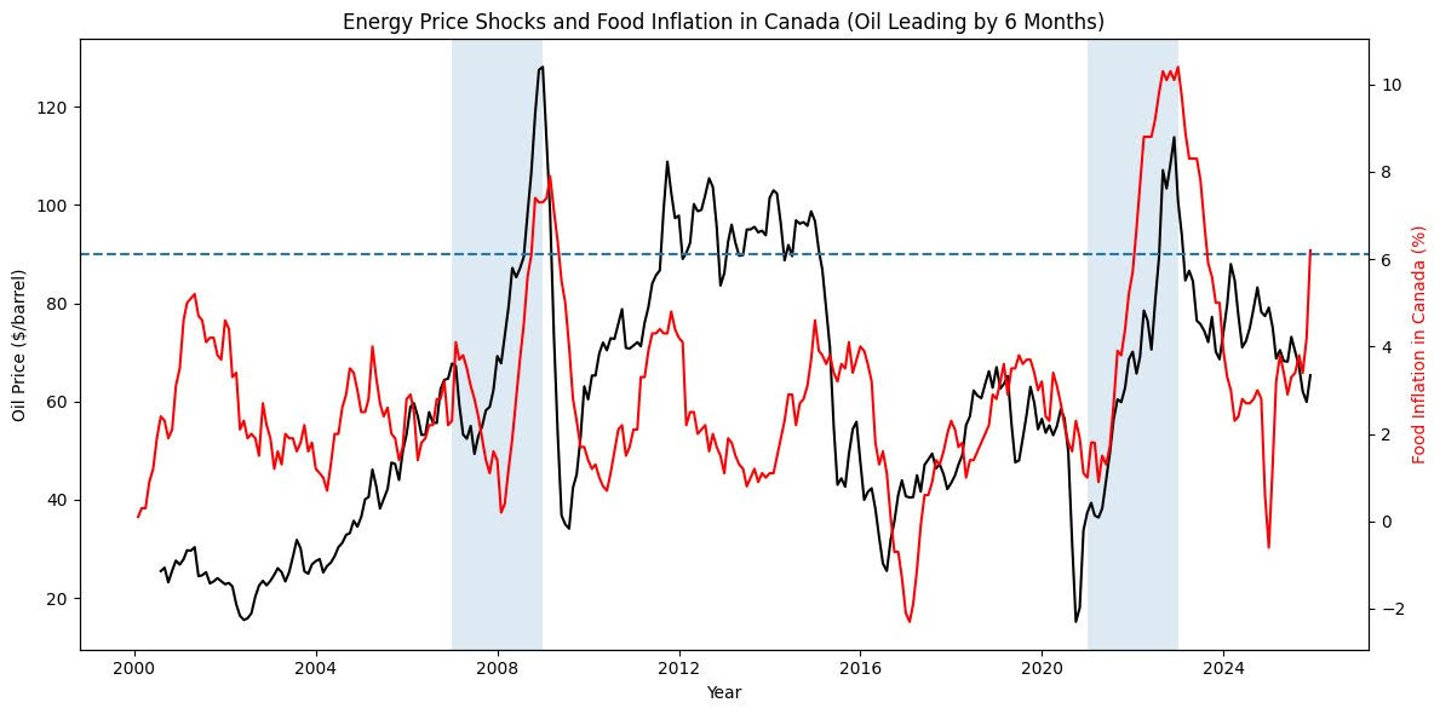
We have seen this movie before. Oil shocks in 2008, 2011 and again in 2022 all triggered noticeable increases in food prices months later. The relationship is not immediate, but it is remarkably consistent. Energy prices typically lead grocery inflation by about six to nine months. When oil rises sharply, food prices tend to follow.
The chart below clearly illustrates the pattern. By shifting oil prices forward by roughly six months, the correlation becomes difficult to ignore. The black line represents oil prices, while the red line shows Canadian food inflation. Time and again, major oil spikes are followed by higher grocery prices.
The latest surge in oil comes after Iranian attacks disrupted shipping routes in the Persian Gulf, injecting fresh uncertainty into global energy markets. If the conflict drags on and oil remains elevated—or worse, climbs beyond $100 per barrel—history suggests food inflation in Canada will not remain where it is today.
OPINION: Why the Iran war could spike grocery prices
Since 2000, every major oil spike has pushed food inflation between one and three percentage points higher. If that pattern holds, today’s energy shock could translate into food inflation reaching between 6% and 8% in 2026.
Our projections for the coming months reflect that risk. If oil prices remain elevated and geopolitical tensions persist, food inflation could climb from roughly 5.2% to 5.6% in May 2026, and 5.6% to 6.1% in June, and potentially 6.0% to 6.6% by July.
READ: Food inflation spiked 7.3% in January. Here's what's driving the increase
The magnitude of the shock is already significant. Oil prices have risen 64% since Jan. 7, a dramatic surge in a very short period of time. Historically, for every 25% sustained increase in oil prices, the average Canadian family’s annual food bill rises by roughly $150 to $200. If current price levels persist, the financial pressure on households will become increasingly difficult to ignore.
Unfortunately, the timing couldn't be worse for Canada.
On April 1, the industrial carbon tax will rise to $110 per metric ton, increasing costs across the energy-intensive sectors that underpin the food supply chain. Combined with rising global oil prices, the result could be a double whammy for farmers, processors, distributors and ultimately consumers.
Energy is embedded in nearly every step of the food system. Fertilizer production relies heavily on natural gas. Farm machinery runs on diesel. Food processing requires heat and electricity. Refrigeration keeps products safe during storage and transportation. And trucks—lots of them—move food across a country as vast as Canada.
When energy prices rise, those costs ripple through the entire chain.
The categories most exposed are animal proteins such as beef and pork, dairy products, and heavily processed foods, all of which require significant energy inputs to produce and distribute. Even staples such as bread and cereals are affected, as higher fuel prices raise the cost of fertilizers and grain drying.
In Canada, geography amplifies the problem. Food often travels thousands of kilometres before reaching store shelves. Sustained energy shocks rarely stay confined to the pump—they eventually appear on grocery receipts.
If oil stabilizes, the damage could be limited. But if prices climb toward $100 and stay there, the warning signs are already visible.
For consumers still recovering from the last wave of food inflation, another one may already be on the horizon.