
The hidden food inflation tax nobody talks about


Something very few people are talking about right now is how recycling policy is quietly adding pressure to food inflation in Canada.
For years, Canadians have tried to understand why food inflation has become such a persistent problem. We’ve debated carbon taxes, labour shortages, transportation costs, supply management, exchange rates, climate events, and corporate concentration. All of these factors matter. But another growing source of inflationary pressure has received remarkably little attention: recycling policy.
READ: Ontario proposes to weaken impending new recycling rules over costs to producers
Across Canada, provinces are rapidly implementing something called Extended Producer Responsibility (EPR) programs, shifting recycling costs from municipalities to manufacturers, processors, retailers, and brand owners. While EPR policies have existed in parts of Canada for years, the major expansion of packaging rules and producer obligations only accelerated between 2021 and this year. As provinces shifted recycling costs onto producers, compliance costs across the food supply chain increased significantly, costs that are now increasingly embedded into grocery prices.
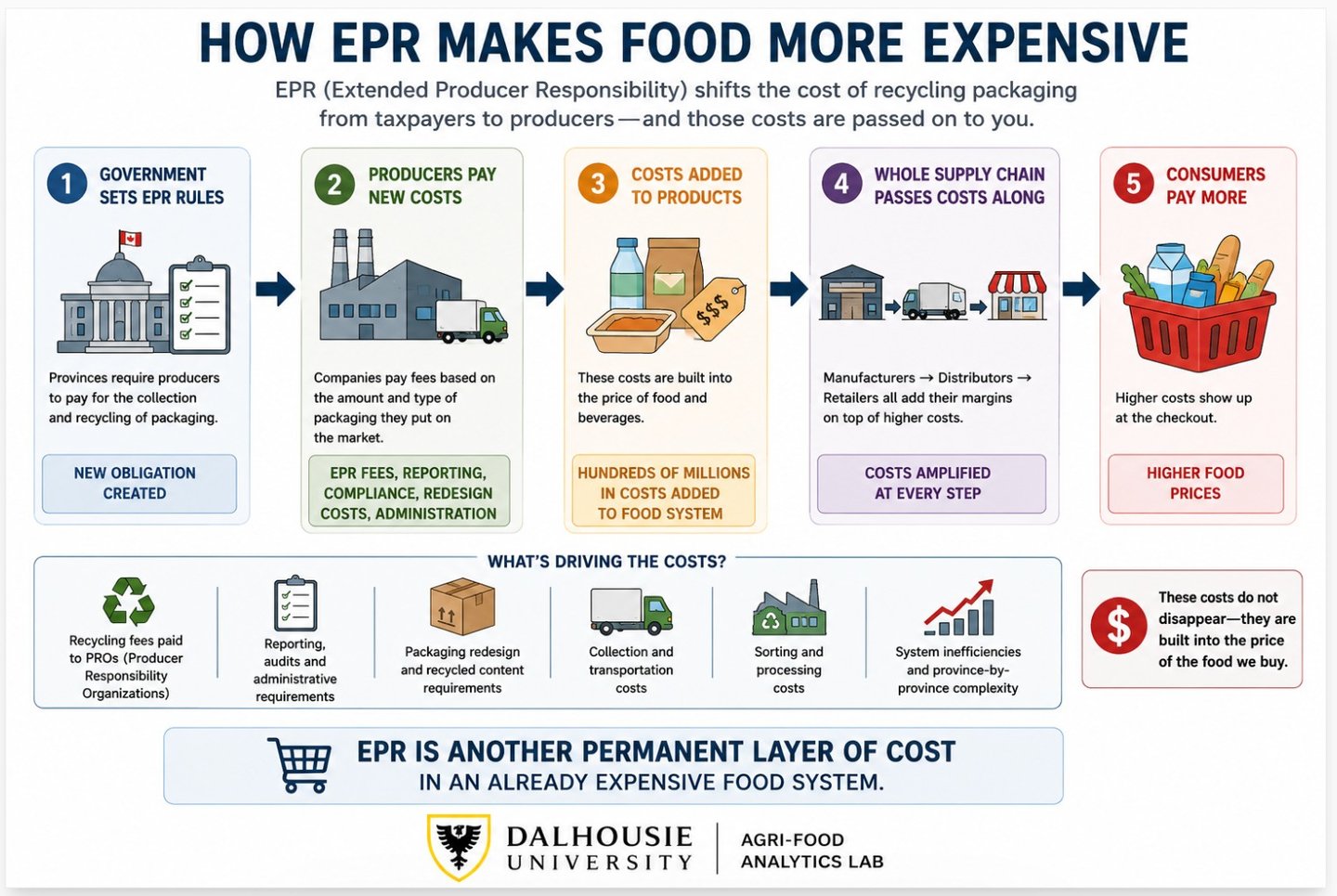
The idea sounds reasonable, make producers responsible for the waste they generate. But food packaging is not like other packaging. It protects safety, extends shelf life, reduces spoilage, enables transportation, and supports food security.
Yet policymakers increasingly treat all packaging as waste.
Quietly, EPR is adding structural costs throughout Canada’s food supply chain. Industry estimates suggest compliance and recycling obligations now total hundreds of millions annually, and those costs inevitably flow into grocery prices. Based on our analysis, EPR-related costs may now be contributing roughly 0.3 to 0.8 percentage points to grocery inflation overall, with some packaging-intensive categories seeing even higher impacts. Prepared meals, frozen foods, soups, sauces, and beverages could be facing inflationary pressures approaching 1 to 1.5% from EPR costs alone. Dairy, meat, bakery products, canned goods, and snacks are also increasingly exposed. That is a lot.
READ: Deal reached to allow grocers to avoid accepting beer and wine empties
No, EPR is not the main reason food prices are rising. Energy, labour, logistics, exchange rates, and commodity volatility remain far more influential. But EPR is becoming another permanent layer of inflationary pressure within an already stressed food system in Canada.
What makes matters worse is Canada’s fragmented approach. Every province has different rules, reporting systems, fee structures, accepted materials, and recycling capabilities. A package considered recyclable in one province may not qualify in another. For national food manufacturers, compliance has become extraordinarily complex and expensive.
Consumers rarely see these costs directly because they are embedded into retail pricing. Unlike bottle deposits or plastic bag fees, EPR functions more like a hidden tax on packaging-intensive sectors like food and beverages.
More concerning, smaller food manufacturers may already be discontinuing niche products because compliance costs have become too burdensome. Regional processors, specialty brands, artisanal frozen foods, seasonal products, and low-volume SKUs are increasingly difficult to justify economically. Ironically, policies meant to improve sustainability may end up reducing consumer choice while favouring larger multinational firms that can absorb compliance costs more easily.
That does not mean EPR is failing entirely. Companies are redesigning packaging, reducing hard-to-recycle materials, and improving recyclability. But Canada should pay attention to models like Oregon’s, where recycling modernization focuses on standardized materials, centralized oversight, measurable environmental outcomes, and system efficiency. Many experts believe Oregon’s approach achieves better environmental results with less administrative friction and potentially less inflationary pressure.
Most importantly, Oregon recognized something Canadian policymakers often overlook: food packaging and environmental sustainability are not enemies. Reducing packaging too aggressively can actually increase food waste, which is often environmentally worse than the packaging itself.
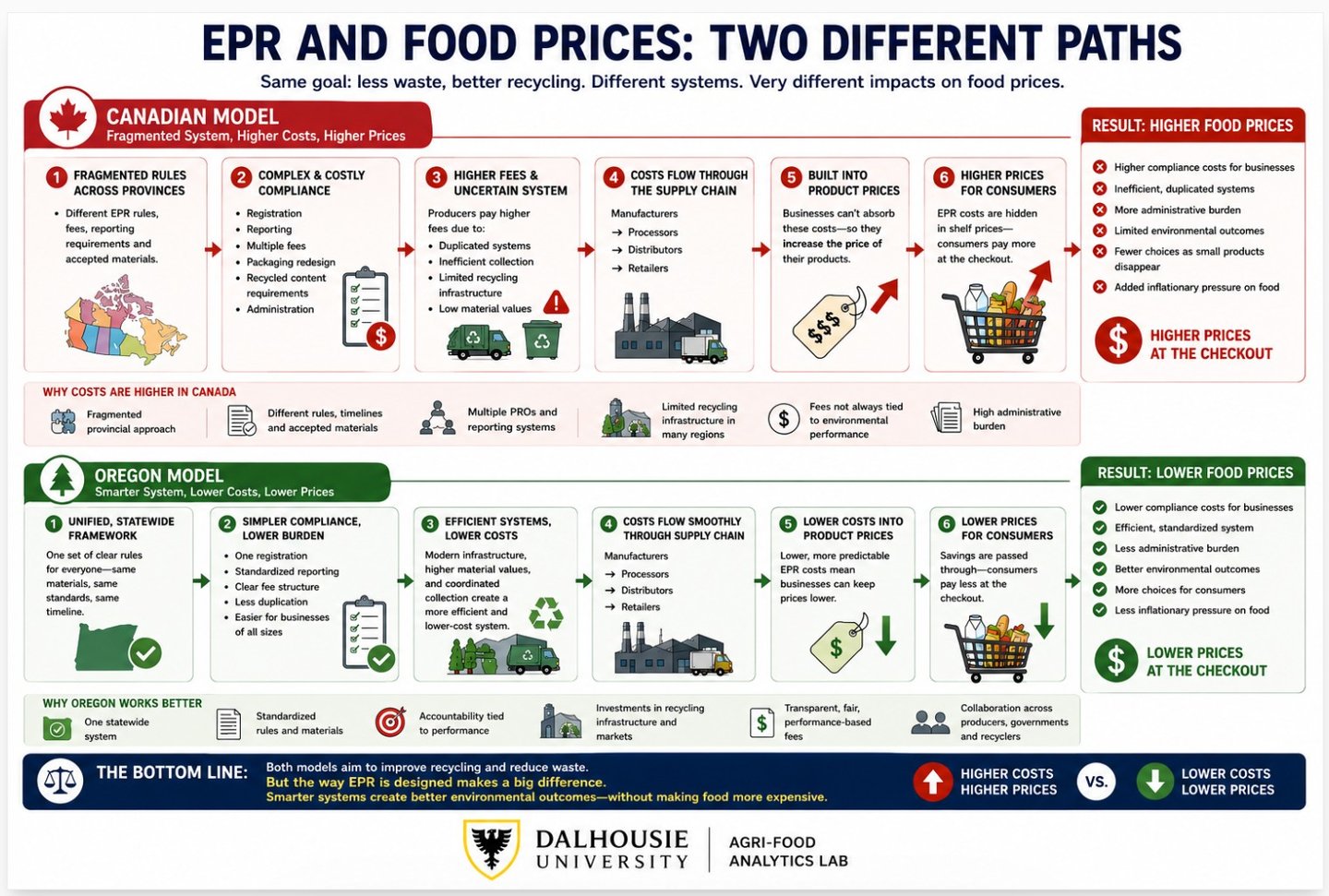
Canada needs a more balanced conversation. Sustainability matters, but policies must also respect affordability, food safety, logistics, and competitiveness. Otherwise, we risk building systems that are expensive, fragmented, bureaucratic, and only marginally more effective environmentally.
Recycling policy is no longer just waste policy.
It is food policy now.