
This year, Easter traditions take a back seat to value

Easter has long been one of the few remaining holidays where tradition dictates the menu. Lamb for many. Ham for most. Turkey, occasionally. But, in 2026, something has shifted—and not subtly. This year, Easter dinner is being decided less by culture and more by cost.
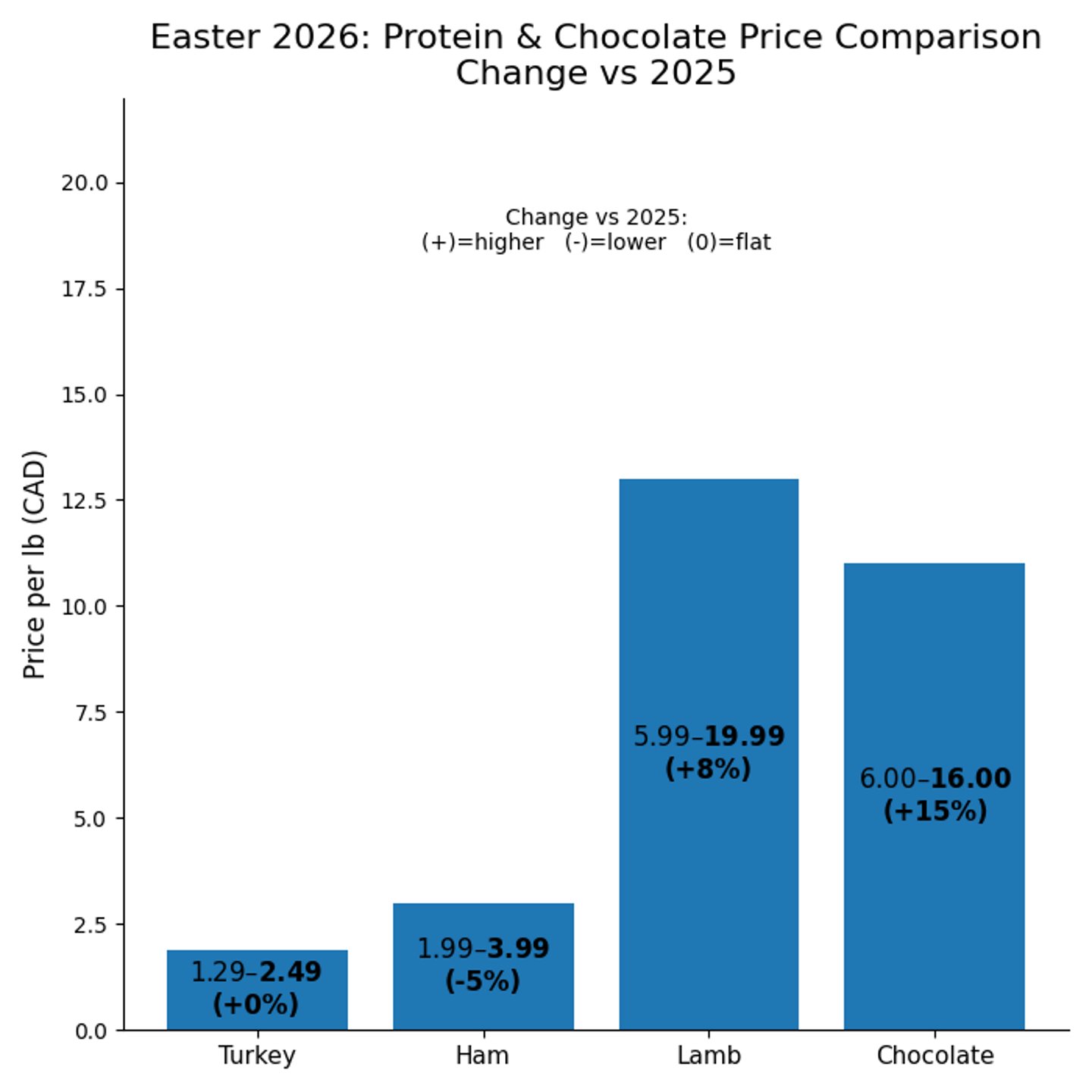
A simple look at retail pricing tells the story. Looking at the data from Flipp, turkey remains aggressively priced at under $2 per pound, unchanged from last year. Ham, the traditional anchor for most Canadian households, is slightly cheaper than in 2025, hovering between $1.99 and $3.99 per pound. And then there is lamb—now firmly in premium territory, often priced between $5.99 and $19.99 per pound, with some cuts climbing far higher. Compared to last year, lamb prices have risen again, widening the gap between it and other proteins.
This is no longer a normal spread. It is a structural divide.
Retailers are doing what they do best in times of consumer stress: they are leaning heavily on promotional proteins to drive traffic. Turkey, in particular, is functioning as a classic loss leader. It’s cheap, abundant and highly visible in flyers. Ham, meanwhile, is being positioned as the compromise—still traditional, still accessible and now more competitively priced than it was a year ago. Together, these two proteins are carrying the burden of affordability.
READ: More than chocolate: Spring’s renewed possibilities for retailers
Chocolate tells a similar story, but for very different reasons. Easter confectionery prices appear noticeably higher than last year, with many products showing 10% to 25% increases on a per-unit basis, and in some cases more when adjusted for weight. Large-format items—such as branded eggs and multi-packs—are now frequently priced between $6 and $16, compared to more common $4 to $13 ranges in 2025.
At the same time, shrinkflation remains widespread, with smaller formats and lighter weights masking some of the inflation. The driver here is not retail strategy, but global commodity pressure. Cocoa prices have surged over the past year due to poor harvests in West Africa, tighter global supply and speculative pressures, leaving retailers with little room to absorb costs. Unlike turkey or ham, chocolate is not being used as a loss leader this season—consumers are paying closer to the true cost of production.
READ: Cocoa prices have come down, but that doesn't mean Easter chocolate will be cheaper
Lamb, however, tells a very different story. Its pricing reflects deeper realities—import dependence, currency pressures, higher production costs abroad and a lack of aggressive promotional support at retail. Unlike turkey or ham, lamb is not being used to bring customers into stores. It is being sold to those who can afford it.
What we are witnessing is the quiet emergence of a “K-shaped Easter.” On one side, households are trading down, opting for turkey or discounted ham to manage grocery bills that remain elevated despite easing inflation. On the other, a smaller segment continues to purchase lamb, absorbing the higher costs without changing behaviour. The middle—once anchored by tradition—is eroding.
This matters more than it may seem. Food is one of the most resilient expressions of culture. When economic pressure begins to alter holiday meals, it signals a deeper shift in consumer reality. Canadians are not just becoming more price-sensitive; they are becoming more strategic. They are shopping more often, comparing more and increasingly substituting—even on occasions that were once immune to such decisions.
Some will argue this is simply rational behaviour in a high-cost environment. And they would be right. But it also underscores a broader point: affordability is no longer a background concern in Canada’s food system. It is now a defining force.
In 2026, Easter dinner is no longer just a meal. It is a reflection of economic conditions, supply chain realities and retail strategy. The widening gap between turkey, ham, lamb—and now even chocolate—is not just about price; it is about access.
And for many Canadians this year, tradition will take a back seat to value.