
Global shocks are driving food prices. Canada's policies are making it worse

Crude oil prices are behaving like the tide these days—moving up and down with unsettling force. Just this past week, prices jumped from roughly $78 on March 10 to above $95 by March 13.
For the food industry, this kind of volatility is far more troubling than a steady rise in energy costs. Gradual increases can be managed. Wild swings cannot.
Food is an energy-intensive business. From fertilizers and farm machinery to refrigerated trucks and distribution networks, the entire food supply chain depends on energy. When oil prices behave like a yo-yo, uncertainty spreads quickly across the system.
The White House’s effort to downplay the uncertainty surrounding energy markets is not helping matters. Logistics providers, transport firms and energy suppliers serving the food sector will naturally price in risk when renegotiating contracts. When uncertainty rises, so do those risk premiums. The result is predictable: higher operating costs across the food supply chain—from farmgate to plate.
OPINION: Why the Iran war could spike grocery prices
Politicizing energy prices and inflation only compounds the problem. The United States, alongside Israel, chose to attack Iran knowing full well the geopolitical consequences. This was never going to be a popularity contest with American voters. But pretending the economic consequences do not exist is equally problematic. Energy markets react to risk, not political messaging.
For Canada, the situation is even more complicated.
On April 1, Canada’s industrial carbon tax will rise to $110 per tonne. As oil prices surge globally, all countries will likely experience upward pressure on food prices. But countries layering additional cost burdens onto their industrial sectors will feel the effects more acutely—and Canada is firmly in that group.
This creates a classic double whammy for Canada’s food supply chain: rising global energy prices combined with a rising domestic carbon tax. The impact will not necessarily be visible to consumers as a specific surcharge. Instead, it will quietly filter through the system until it shows up where it always does—at the grocery checkout.
It is one of Canada’s silent killers of competitiveness.
A recent analysis published by The Hub, written by Charles Lammam, highlights the deeper issue. Canada’s regulatory environment has become increasingly burdensome over the past quarter century. While the U.S. remains among the OECD’s most open and competitive economies, Canada’s regulatory competitiveness has steadily eroded.
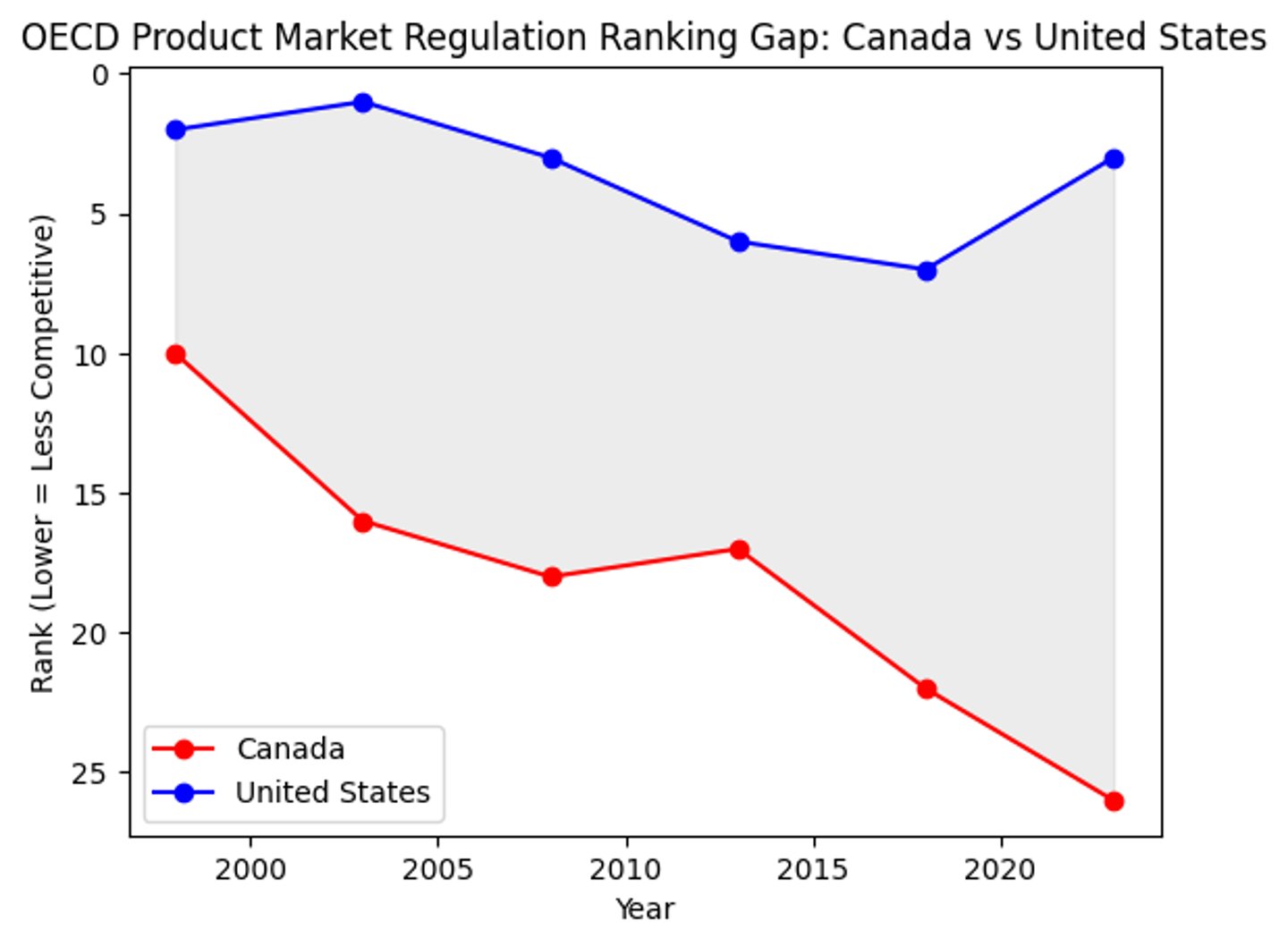
Canada’s regulatory competitiveness has steadily declined over the past 25 years, falling from 10th place in 1998 to 26th in 2023 in the OECD’s Product Market Regulation ranking. Over the same period, the U.S. has remained among the most competitive economies, highlighting a widening regulatory gap between the two countries. The OECD Product Market Regulation ranking measures how restrictive a country’s regulations are for businesses, indicating how easy or difficult it is for firms to enter markets, compete and grow within the economy.
The consequences are significant: weaker investment, lower productivity growth and less efficient supply chains—including in agriculture and food processing.
Many Canadian food companies now prioritize expansion south of the border simply because the regulatory burden is lighter and the market is more predictable. For many firms, selling in the U.S. is simply easier than operating within Canada’s increasingly complex regulatory landscape.
Meanwhile, the geopolitical shock we are experiencing is unlikely to disappear anytime soon. Oil markets remain sensitive to the Iranian conflict, and energy volatility will continue to ripple through food supply chains globally.
Canadians should therefore expect higher food prices.
But blaming global shocks alone misses the bigger picture. Canada’s food inflation problem is increasingly structural. Interprovincial trade barriers, an escalating industrial carbon tax, supply management constraints and logistical inefficiencies all contribute to a system that struggles to absorb external shocks.
READ: Food inflation spiked 7.3% in January. Here's what's driving the increase
The contrast with the U.S. is striking. This week, the U.S. Bureau of Labor Statistics reported that food inflation for food purchased in stores sits at just 2.4%, despite ongoing trade tensions and tariffs. The U.S. economy is simply better equipped to absorb global disruptions.
Canada could be too—but only if we address the structural issues holding our food economy back.
Until then, every geopolitical tremor—from wars to energy shocks—will continue to land harder on Canadian dinner tables than they should.