
The grocery squeeze: How rising prices are eroding financial security for Canadians

Survey after survey tells the same story: Canadians are struggling at the grocery store. And yet, despite the mounting evidence, the situation is not improving.
Our lab has been tracking consumer sentiment on food affordability for years. The latest results, based on a national survey of more than 3,000 Canadians conducted earlier this month, in partnership with Caddle, confirm what many already feel at the checkout: the pressure is not easing.
Yes, food inflation eased slightly to 5.4% in February. But for most households, that number is largely irrelevant. What matters is the total bill—and for many, it remains uncomfortably high.
In fact, 81% of Canadians identified food as the expense that has increased the most over the past 12 months. Not housing. Not energy. Not transportation. Food. That alone should be a wake-up call.
But more concerning is how Canadians are coping. Our data shows that 34% of households have drawn from savings or taken on debt just to put food on the table over the past year. That is not a marginal statistic—it is a structural sign. It suggests that food affordability is no longer being managed through simple budget adjustments. It is now eroding financial resilience.
OPINION: Why Canada leads the G7 in food inflation, again
Canadians are adapting, but not necessarily in ways we should be comfortable with.
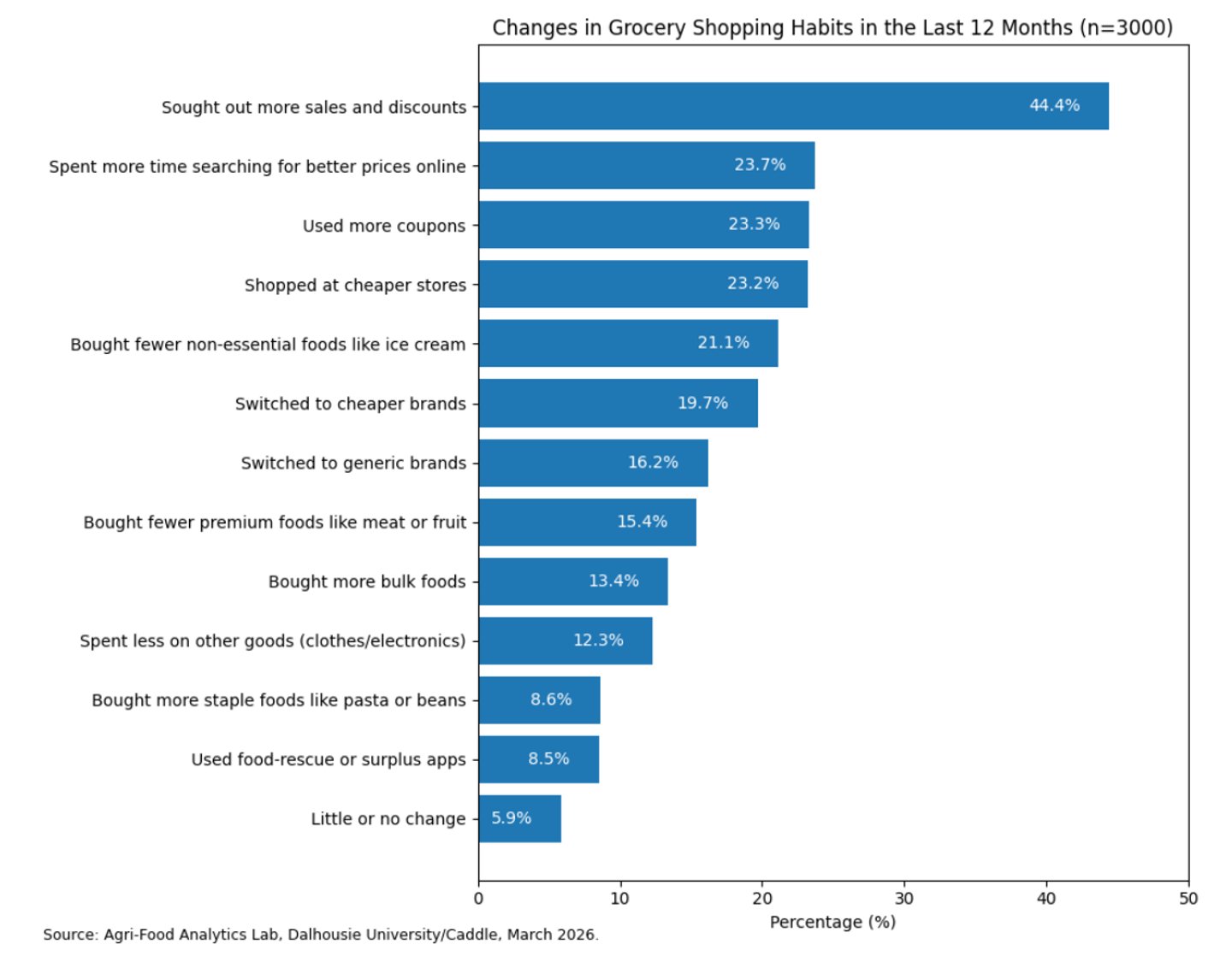
Nearly half of respondents—44.4%—say they are seeking out more sales and discounts. Another 23.7% are spending more time searching online for better prices, while 23.3% report using more coupons. About 23.2% are switching to cheaper stores altogether.
These are not minor adjustments. They represent a fundamental shift in how Canadians shop for food.
At the same time, households are making more difficult trade-offs. About 21.1% say they are buying fewer non-essential items, while 19.7% have switched to cheaper brands and 16.2% are opting for generic products.
Even more telling is what Canadians are removing from their carts.
Roughly 15.4% report buying fewer premium foods such as meat and fresh produce, while 13.4% are buying more bulk items and 8.6% are relying more on staple foods such as pasta and beans. Some are even turning to food-rescue or surplus apps, though adoption remains limited at 8.5%.
Others are making sacrifices beyond food. About 12.3% say they are spending less on goods such as clothing or electronics just to maintain their food consumption.
And despite all of this, only 5.9% of Canadians report making little or no change to their grocery habits.
In other words, almost everyone is adjusting—and most are doing so significantly. Beneath these behaviours lies a deeper shift.
Many households are quietly reshaping their food baskets. They are buying less meat, fewer fresh products and cutting out discretionary items. These decisions help in the short term, but they come with longer-term consequences—particularly when it comes to nutrition and health.
This is not the traditional image of food insecurity. There are no empty shelves. No visible shortages. Instead, what we are seeing is something far more subtle—and arguably more pervasive: a gradual erosion of quality, choice and dietary diversity; a quieter form of food insecurity, unfolding in real time.
And it is largely being misunderstood. Much of the public debate continues to fixate on grocery chains and retail pricing. While scrutiny is warranted, focusing solely on grocers oversimplifies the issue.
Food prices are shaped by a complex system—one that includes energy costs, transportation, labour shortages, regulatory burdens and global commodity markets. Retail is simply where all these pressures converge.
If we are serious about affordability, we need to look beyond the checkout counter. There are deeper structural issues at play.
Since the late 2000s, food prices in Canada have increasingly diverged from overall inflation. At the same time, population growth has accelerated, putting additional strain on supply chains that were never designed for this level of demand.
Yet, policy responses remain fragmented.
Improving productivity in the agri-food sector, reducing interprovincial trade barriers, and strengthening domestic production capacity are not glamorous solutions—but they are necessary ones. So is creating a regulatory environment that allows smaller players to compete and scale.
In the meantime, households are left to absorb the shock. There is no widespread food shortage in Canada. That is not the issue. The issue is that food is becoming one of the most difficult expenses to manage. And when one in three households starts relying on savings or credit to cover basic nutrition, it is no longer just an affordability problem—it is an early warning sign.
Food affordability has always been a cornerstone of Canada’s standard of living. If that foundation continues to weaken, the consequences will extend far beyond the grocery aisle.
The data is clear. Are we ready to act on it?